Events are the appointment records that drive client reminders, and you create, search, edit, bulk edit, and archive them on the Events page.
Events represent any in-person or virtual appointment, such as a court hearing or an office visit. The Events page is where your agency creates those records, attaches clients to them, and keeps them accurate so the assigned flow can generate reminders.
Overview
The Events page combines an Events Calendar, a searchable Events List, a Create Event form, and a Bulk Edit panel on a single screen. Opening an event gives you the full record, including the fields that drive messaging, the attached clients, and a Tools menu for archiving, duplicating, and troubleshooting.
- What it does: Creates, finds, edits, bulk edits, archives, trashes, and restores event records.
- Why it matters: An event needs a date, a flow, and a primary client before eCourtDate can generate reminder messages for it.
- Who uses it: Staff who schedule appointments and the administrators who configure event defaults.
- Expected outcome: Accurate event records that your flows can act on.
The Events group also has Calendars, Waitlists, Checkins, Unreachables, and Schedules tabs across the top of the page.
Prerequisites
Before you manage events, make sure you have:
- An active eCourtDate agency on staging or production
- Super admin access, or a role that includes the events permissions (roles are managed under Admin > Users > Roles)
- Client records already created, if you plan to attach clients to an event
- A flow set up for events, if you want eCourtDate to generate reminders
- Locations set up under Admin > Locations, if you want to set a location on an event
How-To Steps
Create an event
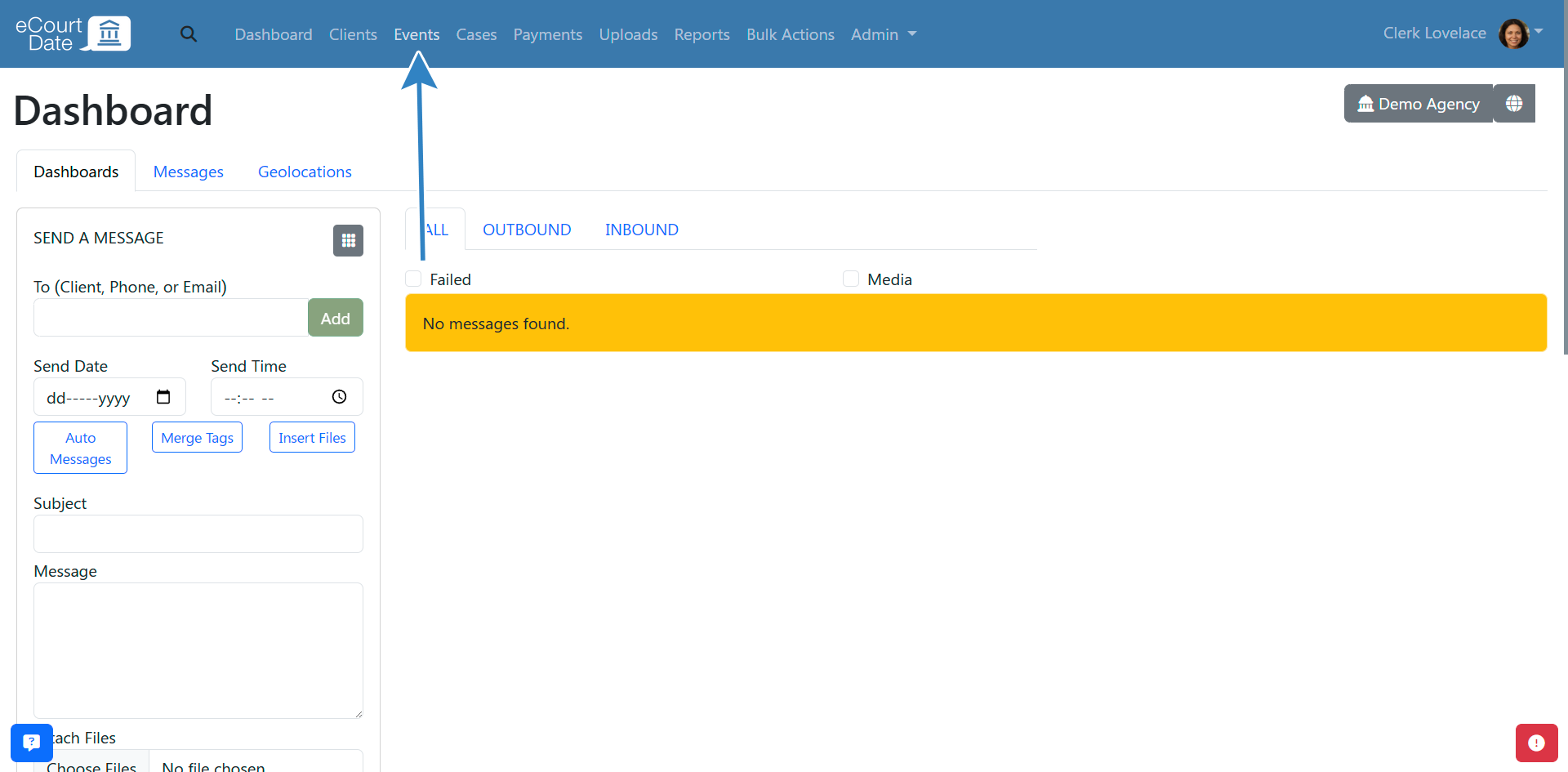
- Click Events in the top navigation.
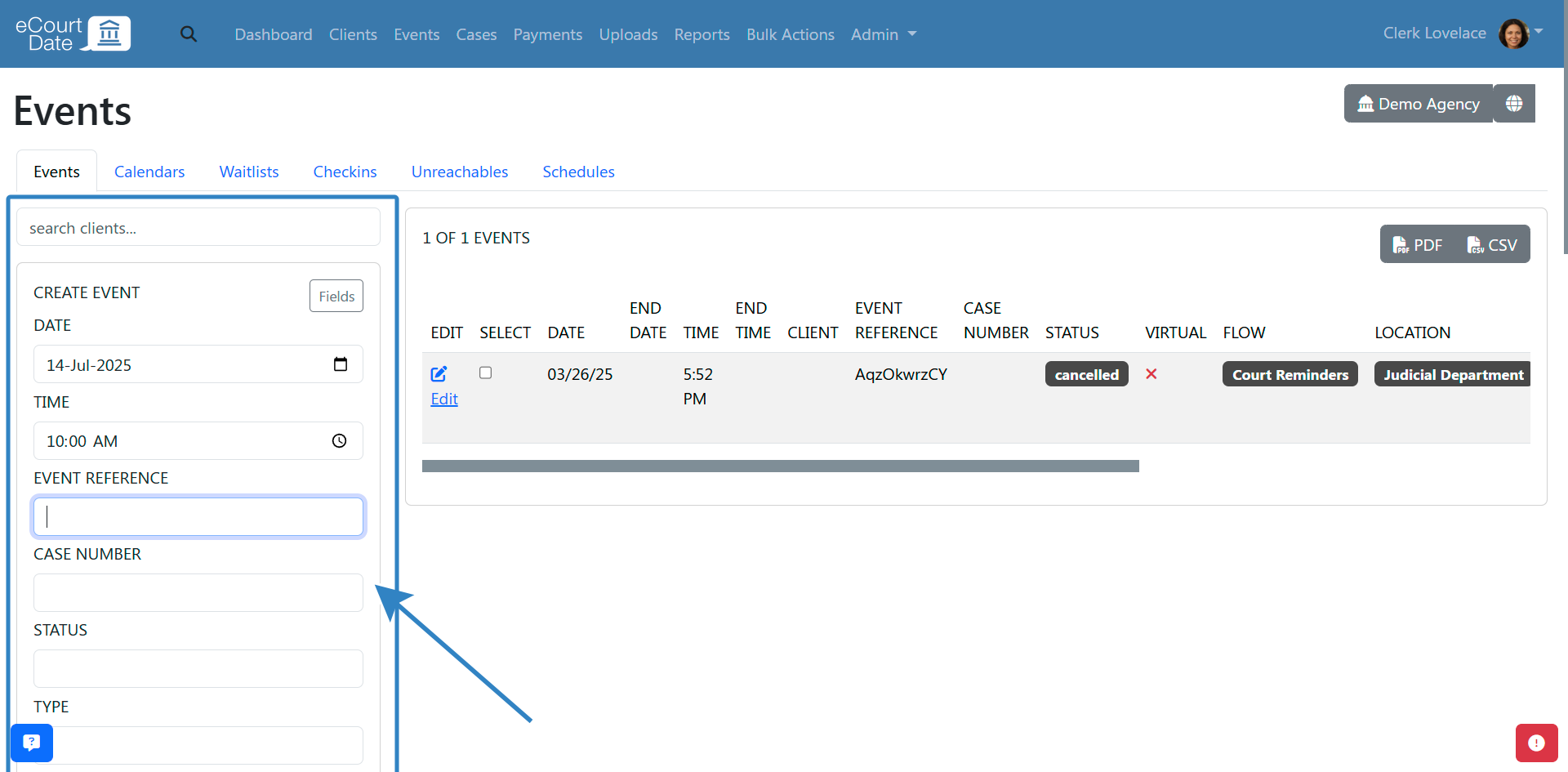
- Enter the Date in the Create Event form.
- Enter the Time.
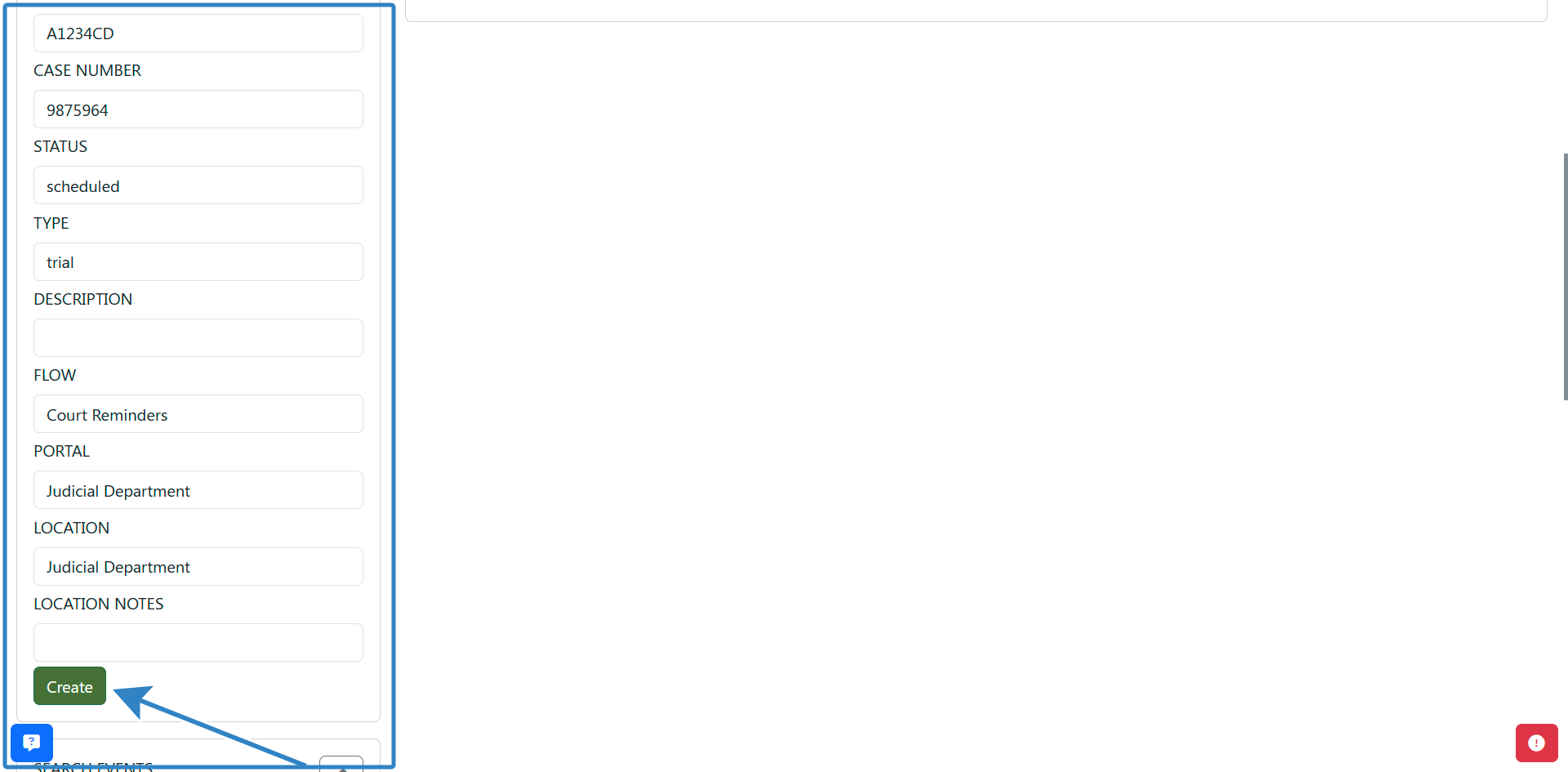
- Complete the other fields you need, such as Event reference, Case number, Status, Type, Description, Flow, Portal, and Location.
- Click Create.
- Click Edit new Event to open the record you just created.
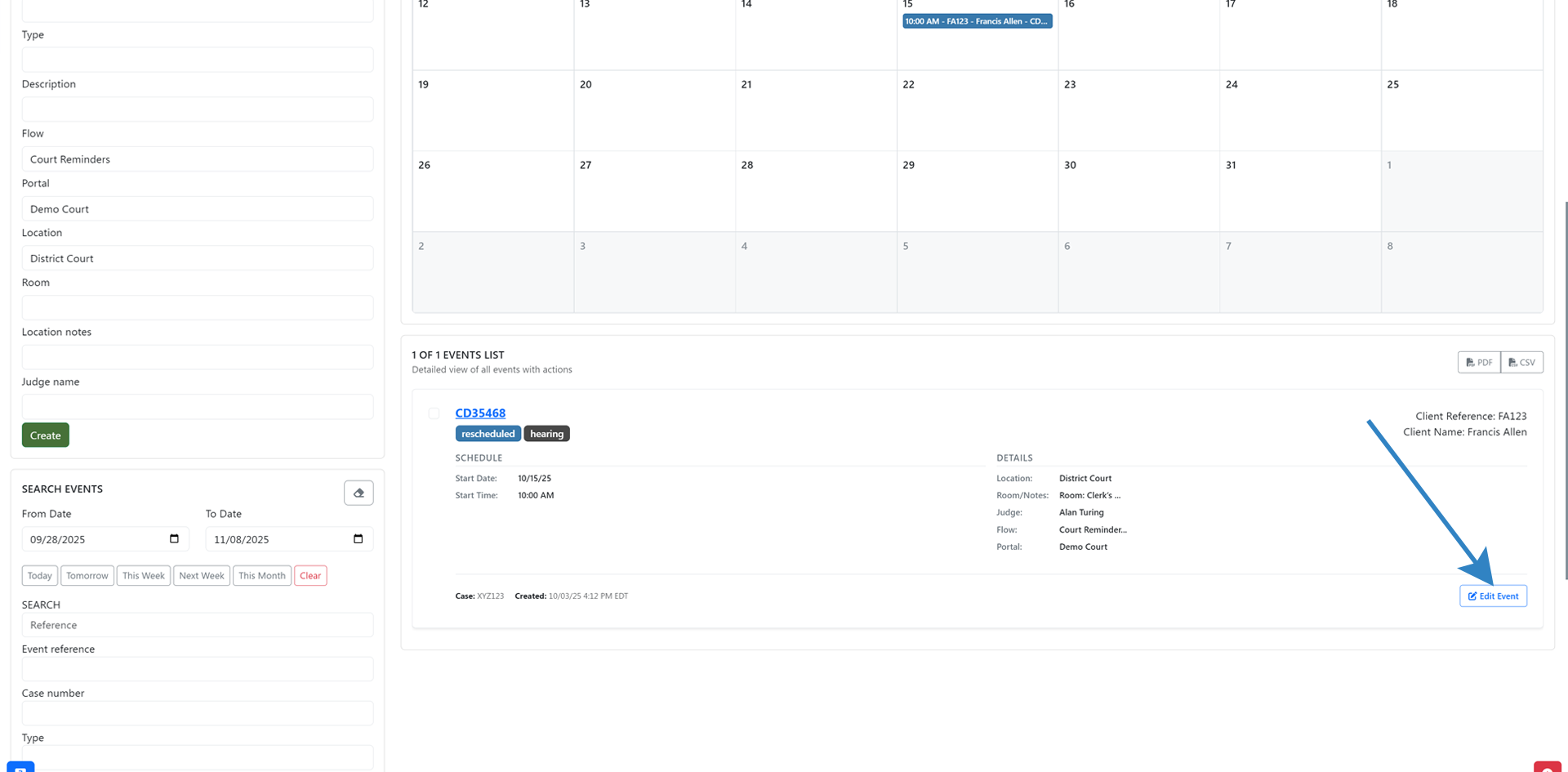
Date and Time are required. Click Fields above the form to show or hide the optional fields. If you select a location that is marked as a Virtual Location, eCourtDate marks the event as virtual for you.
Find an event
- Click Events in the top navigation.
- Set From Date and To Date, or click a quick filter such as Today, Tomorrow, This Week, Next Week, or This Month.
- Enter a reference in SEARCH, or narrow the results with Event reference, Case number, Type, Status, Flow, Location, Judge name, or User.
- Select Virtual to return only virtual events.
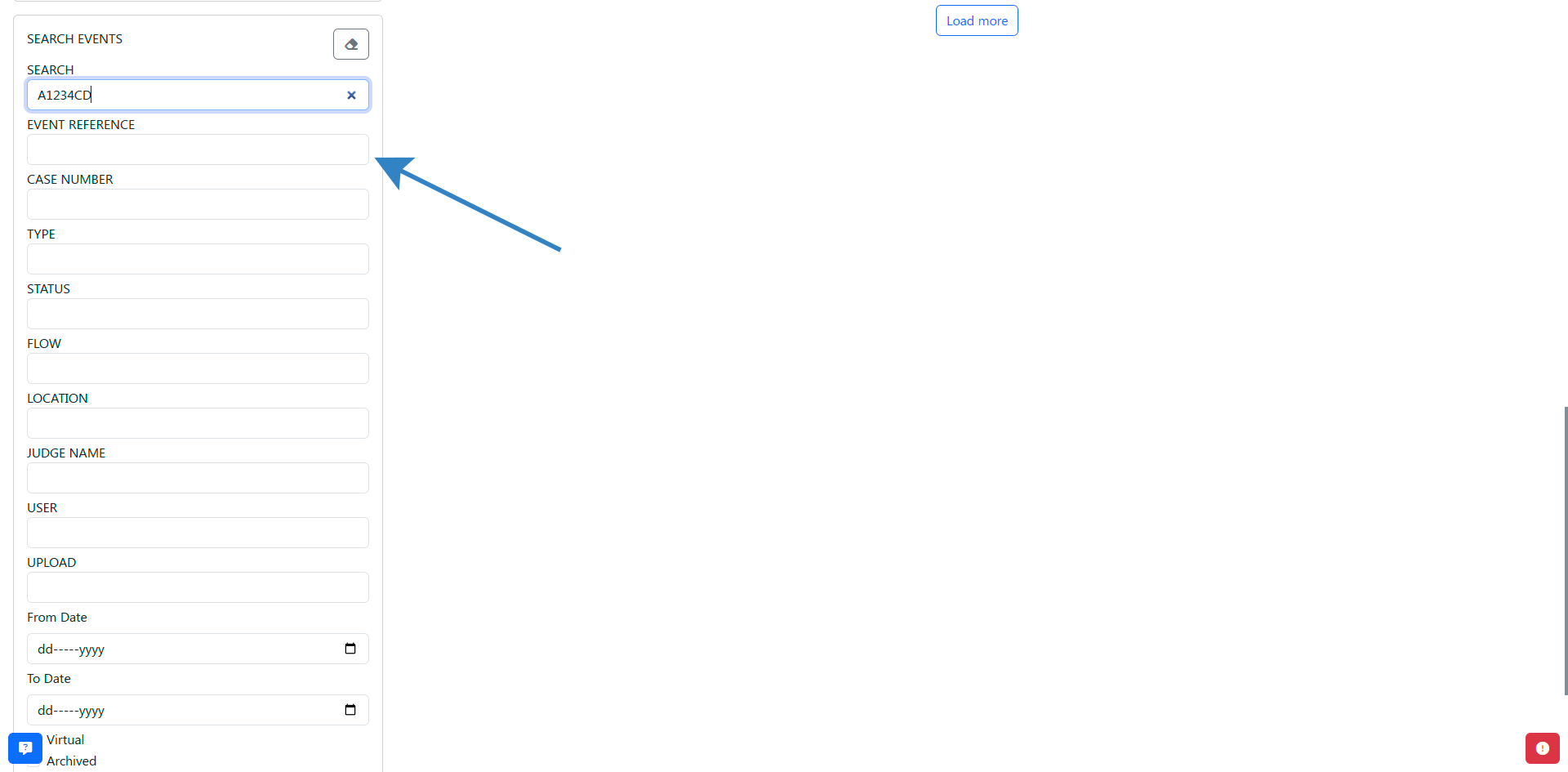
- Click Search.
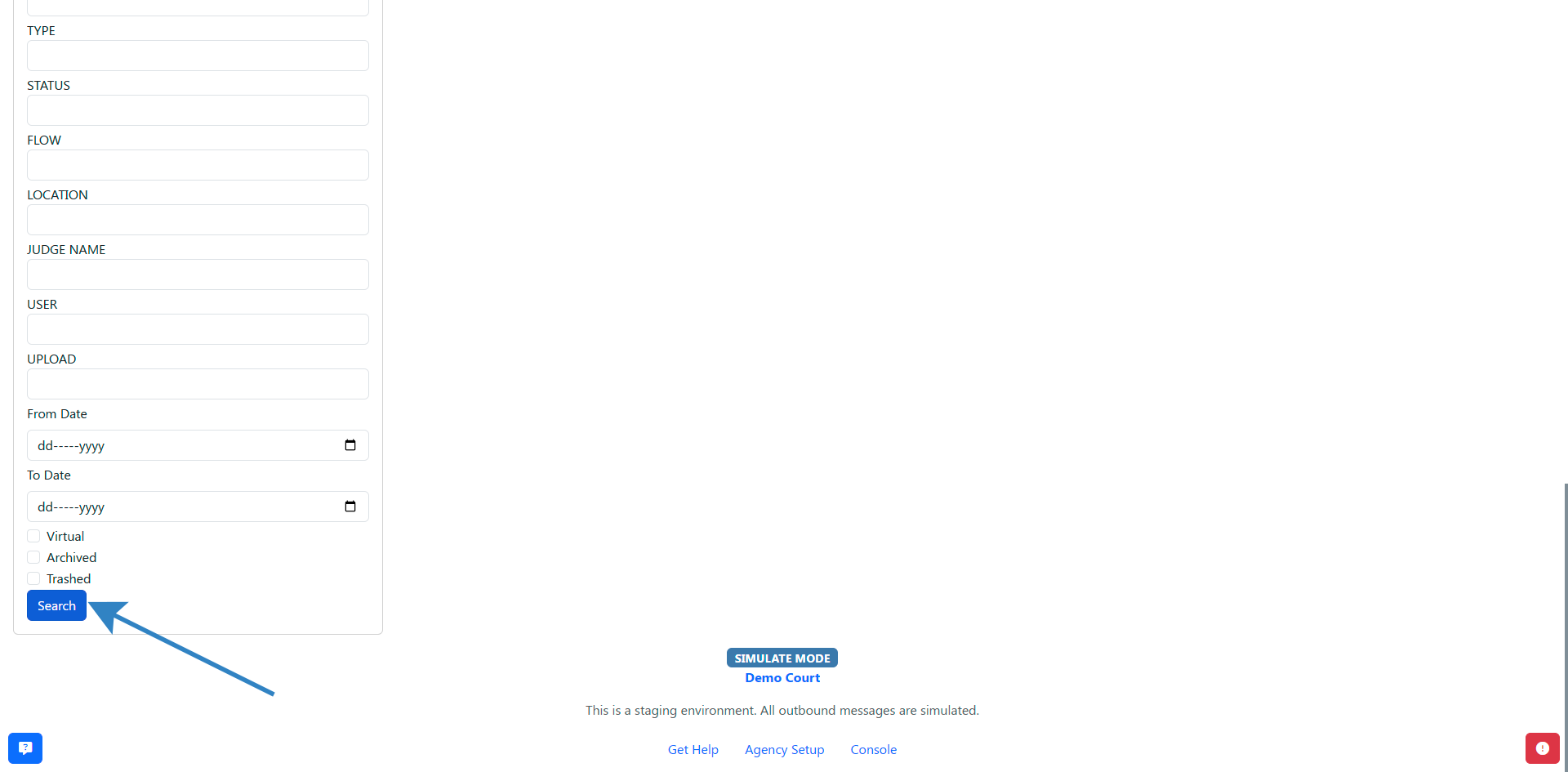
- Click the edit icon on a result to open the event record.
The Events Calendar above the list shows the same results in Year, Month, Week, or Day view, and Today returns you to the current period. Clicking an event in the calendar opens a details window with an Edit Event button. Clicking a day filters the list to that date, and Show all events clears that filter.
Edit an event
- Open the event from the events list.
- Update the fields in the Edit Event card, such as Date, Time, End date, End time, Flow, Location, Status, Appeared, and Internal notes.
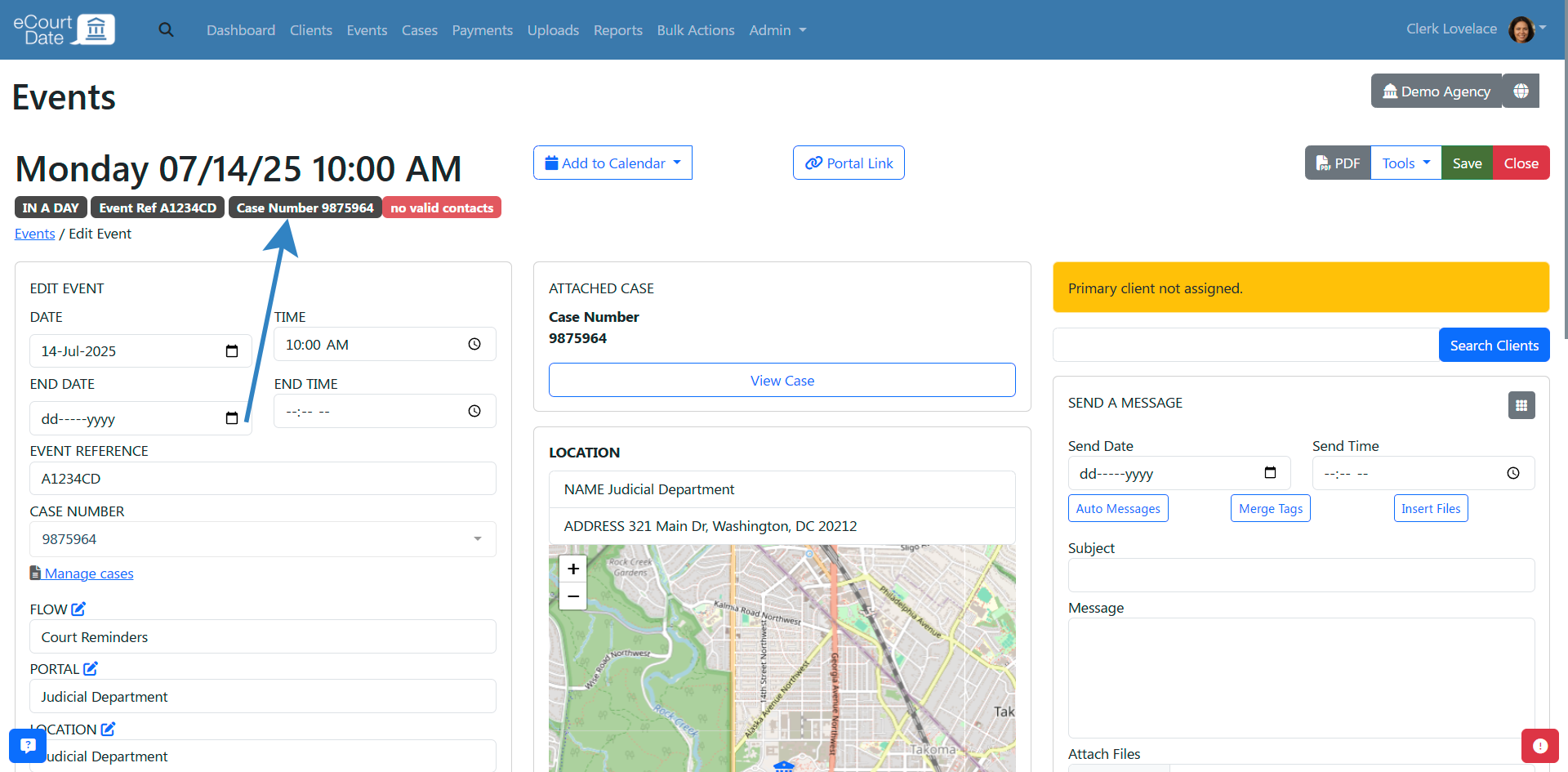
- Click Save.
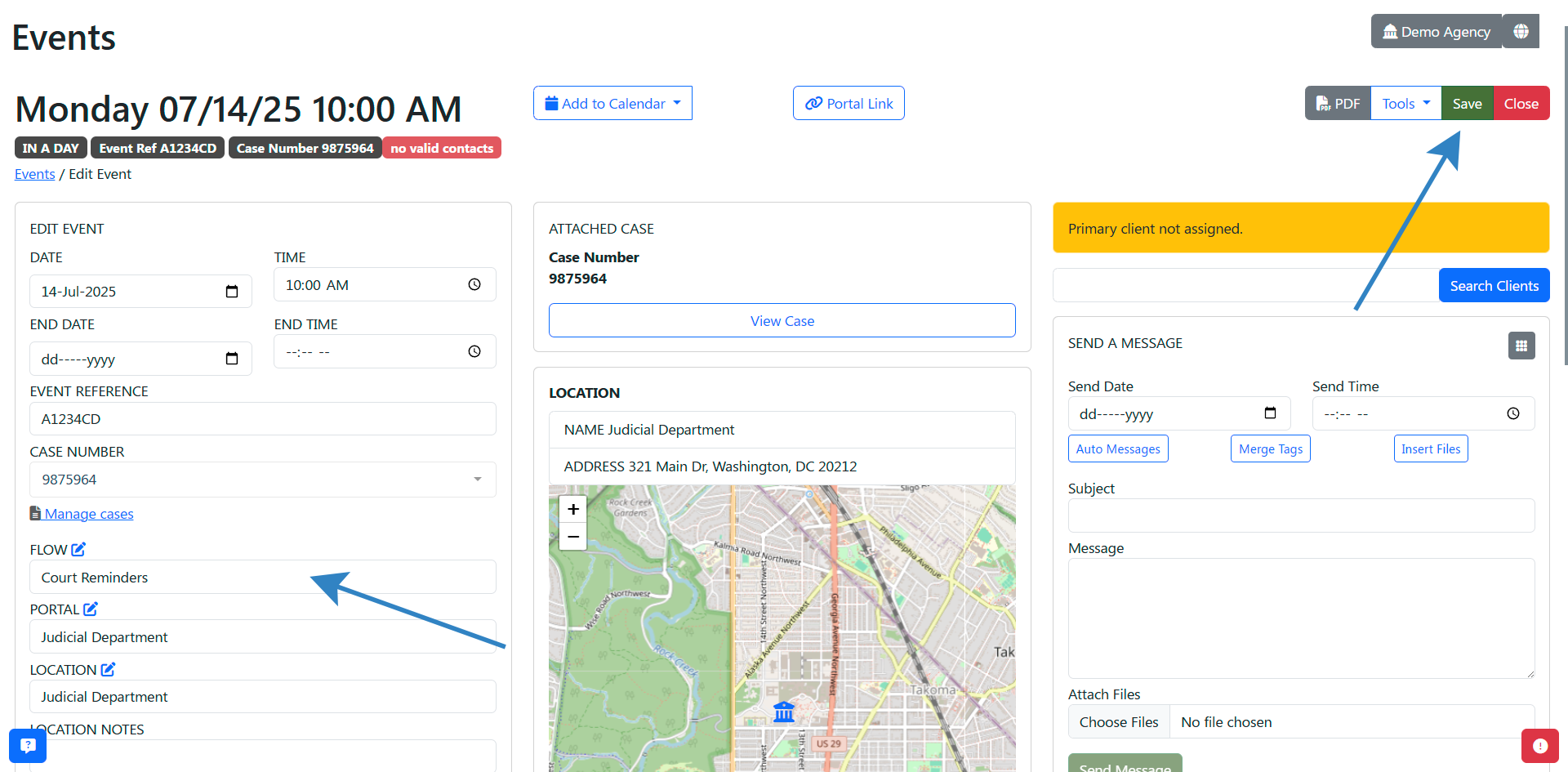
Setting Appeared to FTA marks the record as a Failure to Appear. Selecting IS VIRTUAL adds a Virtual notes field. Click Close to leave the record and return to the events list.
Attach clients to an event
- Open the event.
- Enter a name or reference in the client search box in the right column of the record.
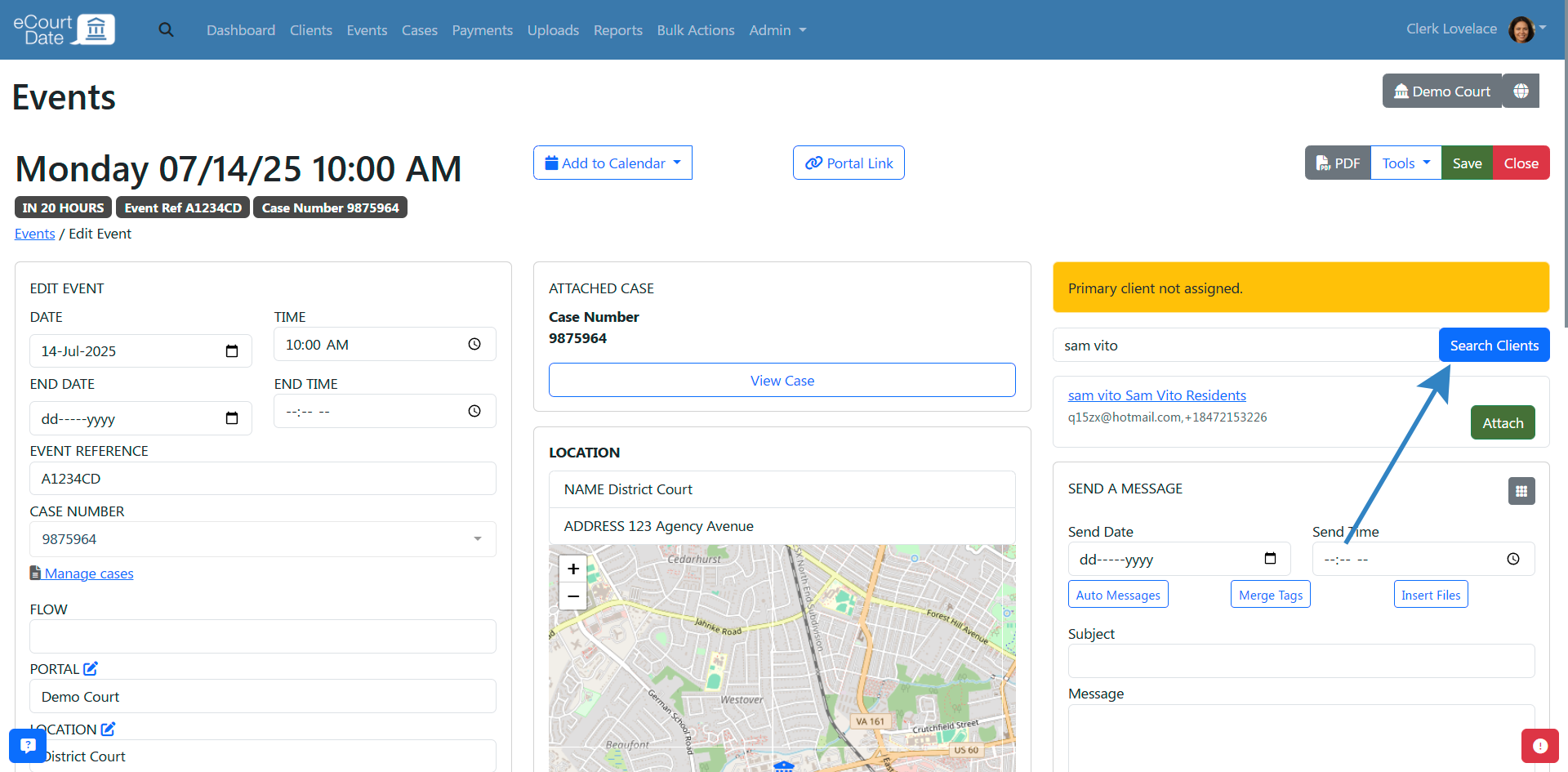
- Click the search button.
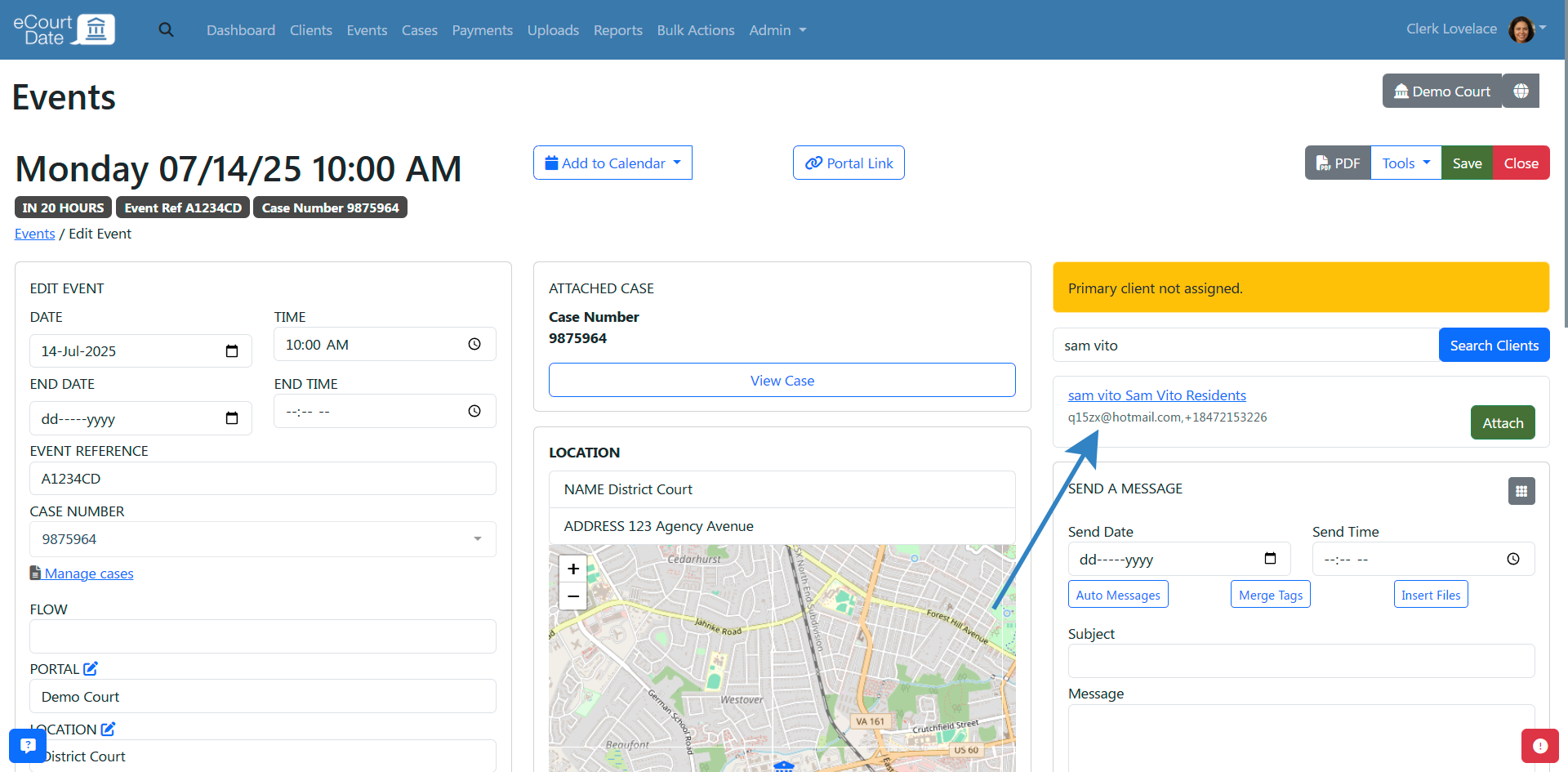
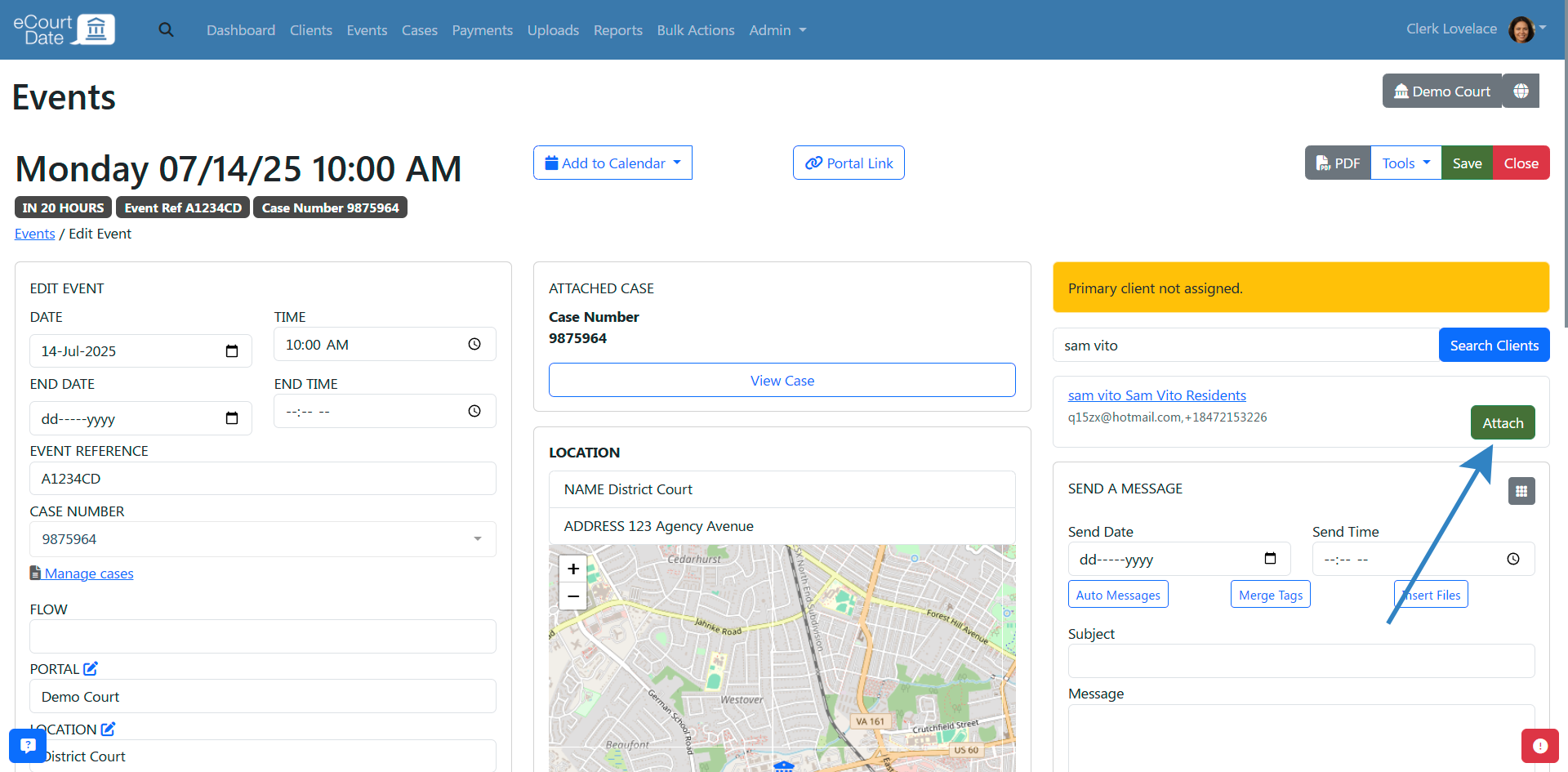
- Click Attach next to the client you want.
- Repeat steps 2 through 4 for every client you need on the event.
- Click Make Primary on a client card to set that client as the primary.
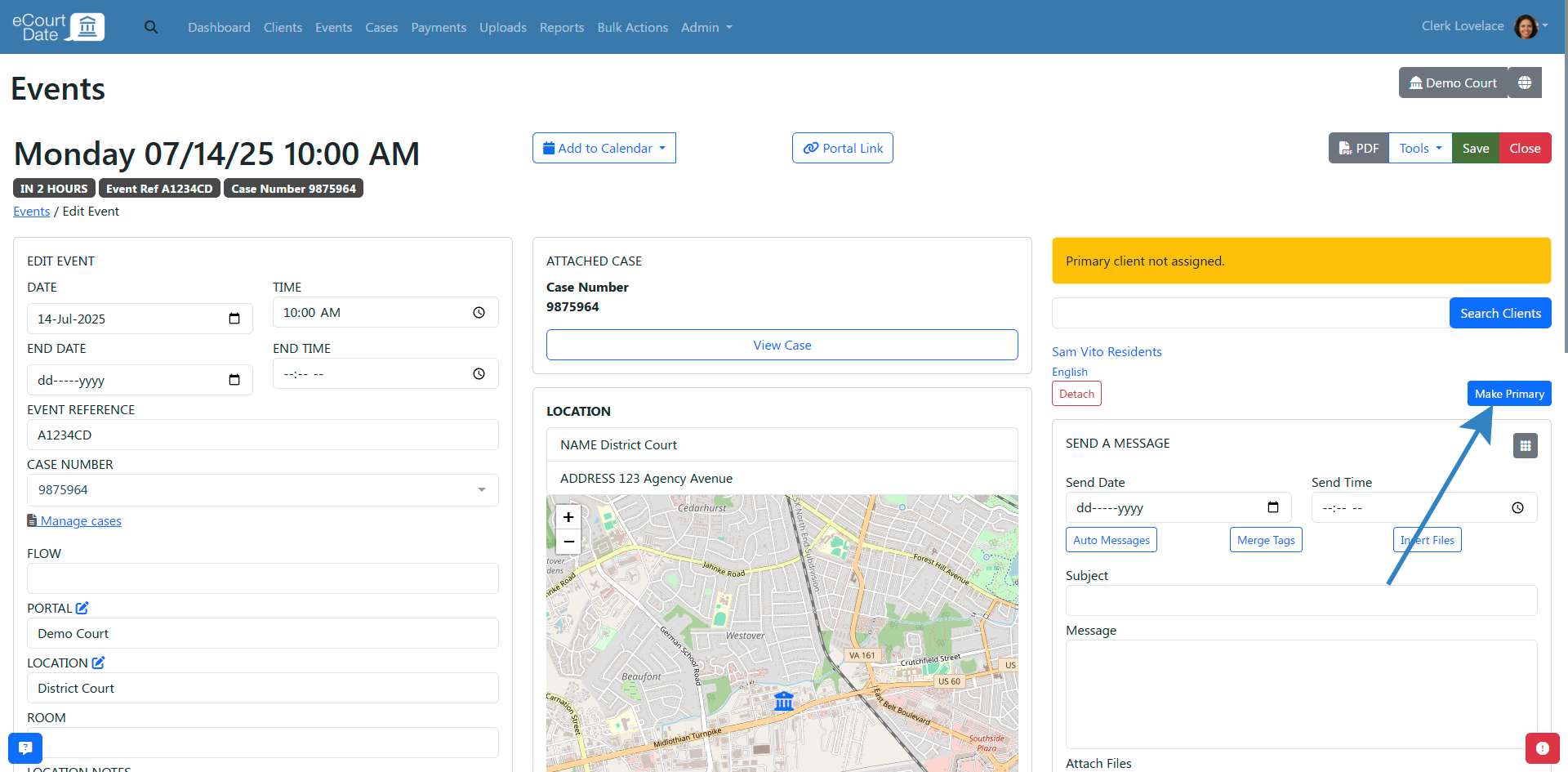
On an event that has no clients yet, that column is headed Attach Clients. Once clients are on the event they appear under Attached Clients with a running count. The primary client appears under Primary Client with a Primary badge, a View Client button, and a Remove Primary Client button. Click Detach on a client card to take that client off the event.
Bulk edit events from the list
- Select the checkbox on each event you want to change, or click Select All.
- Set any of Date, Time, Status, Flow, and Location in the Bulk Edit panel that replaces the Create Event form.
- Click Update.
While events are selected you can also click Archive, Trash, or Restore above the list, then click Confirm on the prompt that appears. Click Deselect All to clear the selection.
Use the Tools menu on an event record
Open an event and click Tools to reach these actions:
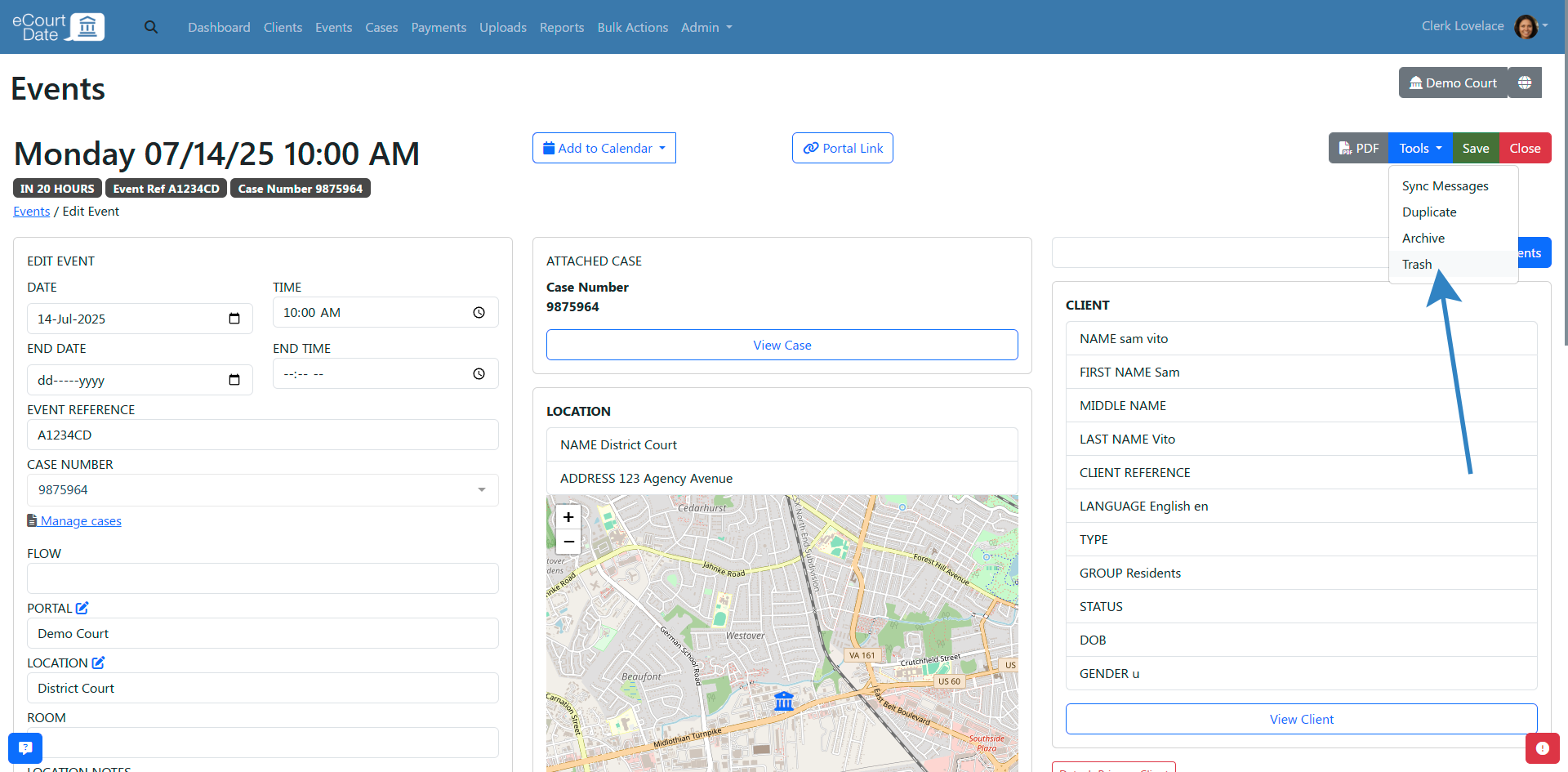
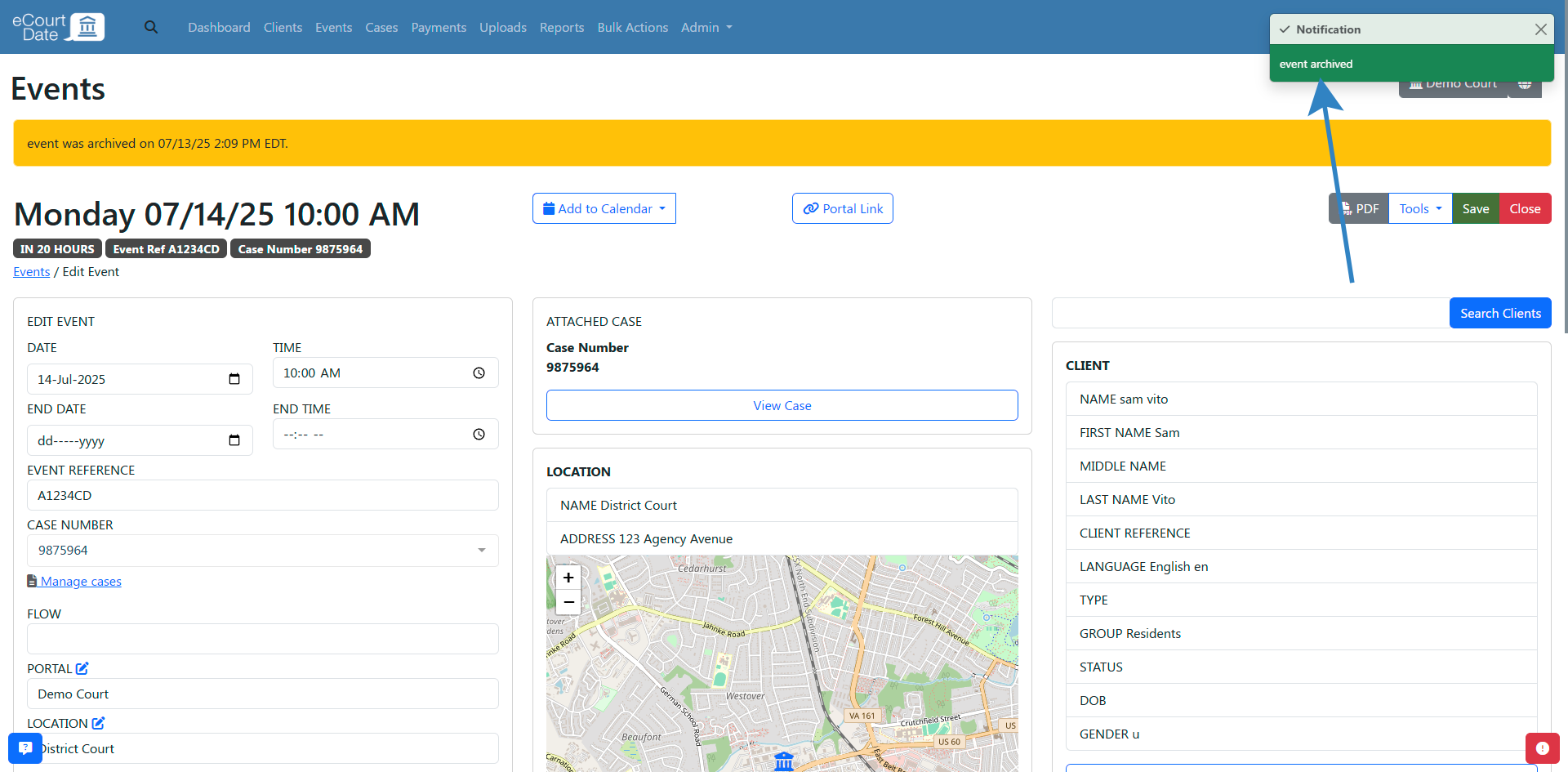
- Archive removes the event from the default list and stamps an archived banner on the record.
- Trash does the same and stamps a trashed banner.
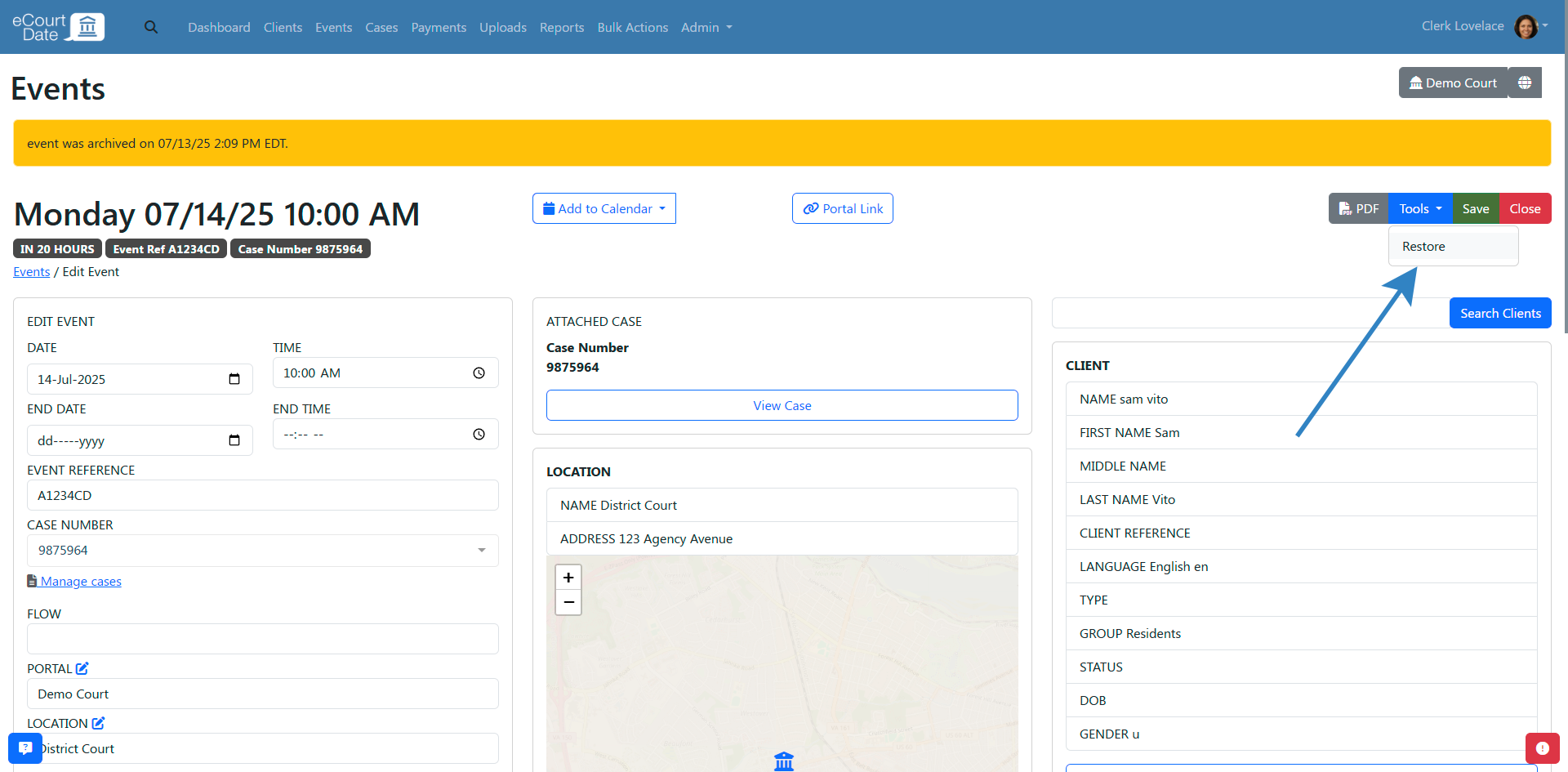
- Restore appears once an event is archived or trashed.
- Sync Messages queues a message resync for the event.
- Duplicate creates a new event from the same details and opens it.
- Troubleshoot opens the checks described in the troubleshooting section below.
Sync Messages and Duplicate are hidden while an event is archived or trashed.
Archive, trash, or restore an event
- Open the event.
- Click Tools.
- Click Archive or Trash.
- Confirm the banner at the top of the record reads "Event was archived on" or "Event was trashed on" with the date and time.
To bring an event back:
- Click Events in the top navigation.
- Select Archived or Trashed in the Search Events form.
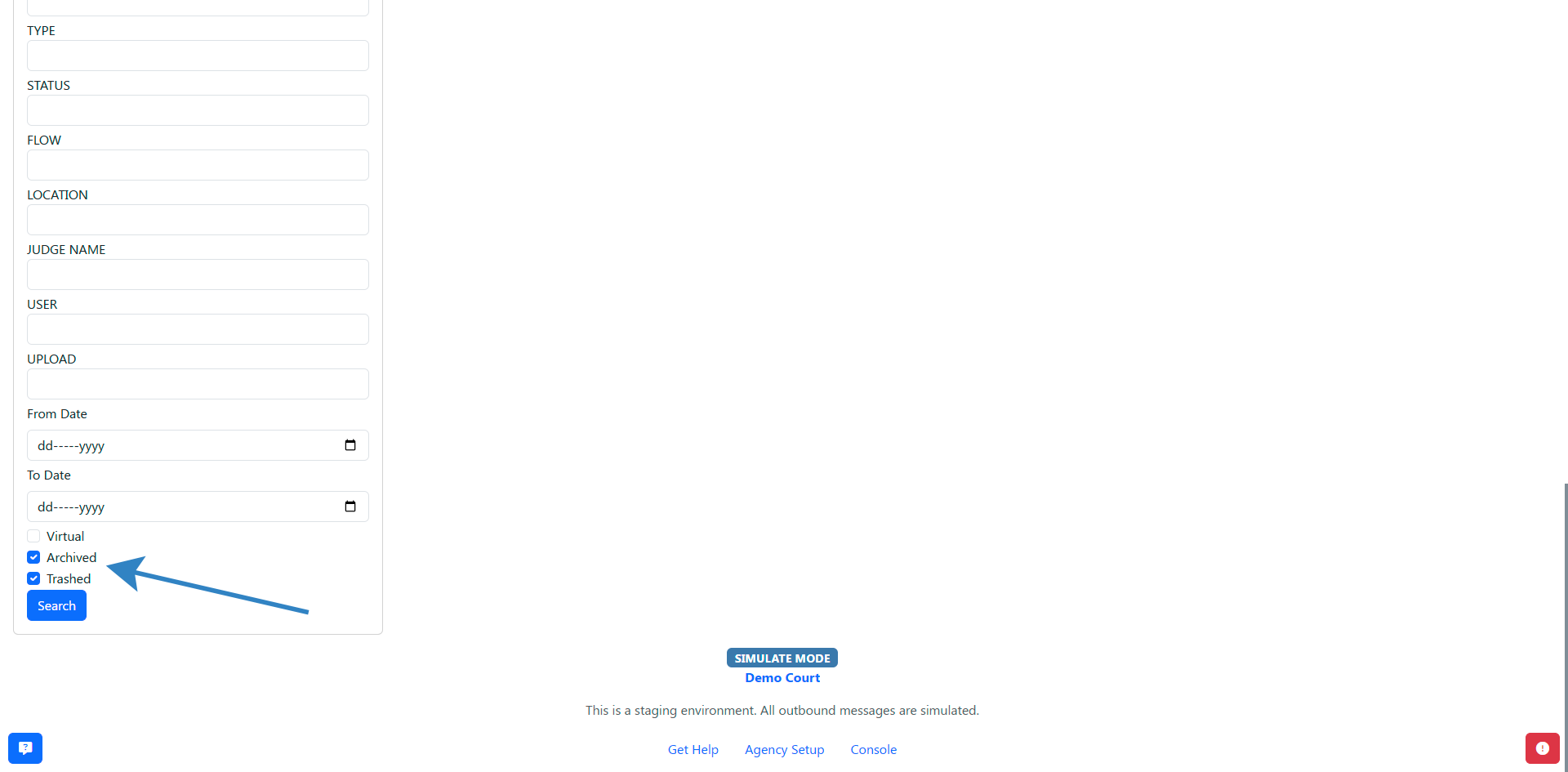
- Click Search.
- Open the event.
- Click Tools > Restore.
Archived and Trashed cannot be selected at the same time, so search for one state at a time.
Export events and add them to a calendar
- Click PDF or CSV above the Events List to download the current results.
- Open an event and click PDF to download that single record.
- Click Add to Calendar on the event record.
- Click iCalendar to download an .ics file, or click Google, Office 365, Outlook, or Yahoo to add the event to that calendar service.
Shareable calendars for your agency are built on the Calendars tab of the Events page.
Enable event check-ins
- Go to Admin > Settings.
- Open the Check-ins and Waitlists section.
- Select Enable Event Check-ins to allow check-ins directly from an event portal.
- Enter Earliest Check-in in hours before the event. It defaults to 24.
- Enter Latest Check-in in hours after the event. It defaults to 24.
- Click Save.
Check-in records are listed on the Checkins tab of the Events page, and the Waitlists tab has its own Check In action that generates a check-in link for an event.
Set event defaults for your agency
- Go to Admin > Settings.
- Open the Events section.
- Set Default Event Type, Primary Judge Name, Available Judge Names, Default Groups, Virtual Platform, or Virtual Base Link.
- Click Save.
Default Event Type is applied to new events when no type is provided, and Primary Judge Name is applied when no judge is provided.
Report on event data
- Go to Analytics > Datapoints.
- Enter a Name in the Create Datapoint form.
- Select events as the Data Source.
- Click Create.
- Go to Analytics > Reports.
- Open a report and add your event datapoints with Add Datapoint.
A report holds up to 20 datapoints and can be sent on an Export Frequency to the addresses listed under Export Recipients.
What to Expect
A new event appears in the Events List and the Events Calendar as soon as you click Create, and the Edit new Event button takes you straight to the record. Bulk edits apply to every selected event at once. Archiving or trashing an event removes it from the default results until you search with the Archived or Trashed filter, and the record carries a banner with the date it happened. Auto Delete Trashed Data under Admin > Settings > Data and Retention defaults to 30 days, and Auto Trash Archived Data defaults to never.
Best Practices
- Assign a Flow and a primary client when you create an event, because the troubleshoot checks treat both as critical for message generation.
- Use Bulk Edit to move a group of events to a new Date, Time, Status, Flow, or Location instead of opening each record.
- Archive rather than trash when you want to keep the record, since trashed data is deleted on the Auto Delete Trashed Data schedule.
- Set Default Event Type and Primary Judge Name under Admin > Settings > Events so new events are consistent.
- Run Tools > Troubleshoot on an event before reporting a missing message.
Frequently Asked Questions
Q: Can I attach more than one client to a single event?
A: Yes. Search for each client in the right column of the event record and click Attach. One of them can be marked with Make Primary, and the rest stay listed under Attached Clients.
Q: How do I find an event I archived or trashed?
A: Select the Archived or Trashed checkbox in the Search Events form and click Search. Only one of the two can be selected at a time.
Q: How long can I recover a trashed event?
A: Auto Delete Trashed Data under Admin > Settings > Data and Retention controls this and defaults to 30 days. Auto Trash Archived Data defaults to never, so archived events stay until you change that setting.
Q: Can I copy an event instead of retyping it?
A: Yes. Open the event and click Tools > Duplicate. eCourtDate creates a new event from the same details and opens it, without carrying over the client, the Appeared value, or the created and updated stamps.
Q: Can I add an event to my own calendar?
A: Click Add to Calendar on the event record, then click iCalendar for an .ics file or click Google, Office 365, Outlook, or Yahoo.
Troubleshooting
Issue: No messages are generated for an event.
Symptoms: The event has a flow assigned, but Messages Created stays at 0 on the troubleshoot screen.
Solution:
- Open the event and click Tools > Troubleshoot.
- Review the Summary counts and the Critical Issues card.
- Fix any critical issue it reports, such as no primary client assigned, no flow assigned, the flow having no messages, no valid opted-in contacts, an event status that disables messages, or a location with messages disabled.
- Click Re-run Checks to confirm the issue is cleared.
- Return to the record and click Tools > Sync Messages.
Issue: An event is missing from the events list.
Symptoms: The list shows "No Events Found" even though you know the event exists.
Solution:
- Click Clear to drop the date range, or widen From Date and To Date.
- Click the reset button on the Search Events card to clear every filter.
- Select Archived or Trashed and click Search in case the event was removed from the default results.
Issue: The Bulk Edit panel is not showing.
Symptoms: The left column still shows the Create Event form.
Solution:
- Select the checkbox on at least one event in the Events List.
- Confirm the count reads as selected above the Bulk Edit fields.
- Set the fields you want to change and click Update.
Important: If you continue to experience issues after following these troubleshooting steps, sign in to eCourtDate and create a ticket by clicking the ticket button in the bottom right corner of the screen.
Related Articles
Events represent any in-person or virtual appointment, such as a court hearing or an office visit. The **Events** page is where your agency creates those records, attaches clients to them, and keeps them accurate so the assigned flow can generate reminders.
### Overview
The **Events** page combines an **Events Calendar**, a searchable **Events List**, a **Create Event** form, and a **Bulk Edit** panel on a single screen. Opening an event gives you the full record, including the fields that drive messaging, the attached clients, and a **Tools** menu for archiving, duplicating, and troubleshooting.
- **What it does:** Creates, finds, edits, bulk edits, archives, trashes, and restores event records.
- **Why it matters:** An event needs a date, a flow, and a primary client before eCourtDate can generate reminder messages for it.
- **Who uses it:** Staff who schedule appointments and the administrators who configure event defaults.
- **Expected outcome:** Accurate event records that your flows can act on.
The **Events** group also has **Calendars**, **Waitlists**, **Checkins**, **Unreachables**, and **Schedules** tabs across the top of the page.
### Prerequisites
Before you manage events, make sure you have:
- An active eCourtDate agency on [staging](https://staging.ecourtdate.com) or [production](https://app.ecourtdate.com)
- Super admin access, or a role that includes the events permissions (roles are managed under **Admin** > **Users** > **Roles**)
- Client records already created, if you plan to attach clients to an event
- A flow set up for events, if you want eCourtDate to generate reminders
- Locations set up under **Admin** > **Locations**, if you want to set a location on an event
### How-To Steps
#### Create an event
1. Click **Events** in the top navigation.

2. Enter the **Date** in the **Create Event** form.
3. Enter the **Time**.
4. Complete the other fields you need, such as **Event reference**, **Case number**, **Status**, **Type**, **Description**, **Flow**, **Portal**, and **Location**.

5. Click **Create**.

6. Click **Edit new Event** to open the record you just created.

**Date** and **Time** are required. Click **Fields** above the form to show or hide the optional fields. If you select a location that is marked as a **Virtual Location**, eCourtDate marks the event as virtual for you.
#### Find an event
1. Click **Events** in the top navigation.
2. Set **From Date** and **To Date**, or click a quick filter such as **Today**, **Tomorrow**, **This Week**, **Next Week**, or **This Month**.
3. Enter a reference in **SEARCH**, or narrow the results with **Event reference**, **Case number**, **Type**, **Status**, **Flow**, **Location**, **Judge name**, or **User**.
4. Select **Virtual** to return only virtual events.

5. Click **Search**.

6. Click the edit icon on a result to open the event record.
The **Events Calendar** above the list shows the same results in **Year**, **Month**, **Week**, or **Day** view, and **Today** returns you to the current period. Clicking an event in the calendar opens a details window with an **Edit Event** button. Clicking a day filters the list to that date, and **Show all events** clears that filter.
#### Edit an event
1. Open the event from the events list.
2. Update the fields in the **Edit Event** card, such as **Date**, **Time**, **End date**, **End time**, **Flow**, **Location**, **Status**, **Appeared**, and **Internal notes**.

3. Click **Save**.

Setting **Appeared** to FTA marks the record as a Failure to Appear. Selecting **IS VIRTUAL** adds a **Virtual notes** field. Click **Close** to leave the record and return to the events list.
#### Attach clients to an event
1. Open the event.
2. Enter a name or reference in the client search box in the right column of the record.

3. Click the search button.

4. Click **Attach** next to the client you want.

5. Repeat steps 2 through 4 for every client you need on the event.
6. Click **Make Primary** on a client card to set that client as the primary.

On an event that has no clients yet, that column is headed **Attach Clients**. Once clients are on the event they appear under **Attached Clients** with a running count. The primary client appears under **Primary Client** with a **Primary** badge, a **View Client** button, and a **Remove Primary Client** button. Click **Detach** on a client card to take that client off the event.
#### Bulk edit events from the list
1. Select the checkbox on each event you want to change, or click **Select All**.
2. Set any of **Date**, **Time**, **Status**, **Flow**, and **Location** in the **Bulk Edit** panel that replaces the **Create Event** form.
3. Click **Update**.
While events are selected you can also click **Archive**, **Trash**, or **Restore** above the list, then click **Confirm** on the prompt that appears. Click **Deselect All** to clear the selection.
#### Use the Tools menu on an event record
Open an event and click **Tools** to reach these actions:
- **Archive** removes the event from the default list and stamps an archived banner on the record.
- **Trash** does the same and stamps a trashed banner.
- **Restore** appears once an event is archived or trashed.
- **Sync Messages** queues a message resync for the event.
- **Duplicate** creates a new event from the same details and opens it.
- **Troubleshoot** opens the checks described in the troubleshooting section below.
**Sync Messages** and **Duplicate** are hidden while an event is archived or trashed.
#### Archive, trash, or restore an event
1. Open the event.
2. Click **Tools**.
3. Click **Archive** or **Trash**.

4. Confirm the banner at the top of the record reads "Event was archived on" or "Event was trashed on" with the date and time.

To bring an event back:
1. Click **Events** in the top navigation.
2. Select **Archived** or **Trashed** in the **Search Events** form.

3. Click **Search**.
4. Open the event.
5. Click **Tools** > **Restore**.

**Archived** and **Trashed** cannot be selected at the same time, so search for one state at a time.
#### Export events and add them to a calendar
1. Click **PDF** or **CSV** above the **Events List** to download the current results.
2. Open an event and click **PDF** to download that single record.
3. Click **Add to Calendar** on the event record.
4. Click **iCalendar** to download an .ics file, or click **Google**, **Office 365**, **Outlook**, or **Yahoo** to add the event to that calendar service.
Shareable calendars for your agency are built on the **Calendars** tab of the **Events** page.
#### Enable event check-ins
1. Go to **Admin** > **Settings**.
2. Open the **Check-ins and Waitlists** section.
3. Select **Enable Event Check-ins** to allow check-ins directly from an event portal.
4. Enter **Earliest Check-in** in hours before the event. It defaults to 24.
5. Enter **Latest Check-in** in hours after the event. It defaults to 24.
6. Click **Save**.
Check-in records are listed on the **Checkins** tab of the **Events** page, and the **Waitlists** tab has its own **Check In** action that generates a check-in link for an event.
#### Set event defaults for your agency
1. Go to **Admin** > **Settings**.
2. Open the **Events** section.
3. Set **Default Event Type**, **Primary Judge Name**, **Available Judge Names**, **Default Groups**, **Virtual Platform**, or **Virtual Base Link**.
4. Click **Save**.
**Default Event Type** is applied to new events when no type is provided, and **Primary Judge Name** is applied when no judge is provided.
#### Report on event data
1. Go to **Analytics** > **Datapoints**.
2. Enter a **Name** in the **Create Datapoint** form.
3. Select **events** as the **Data Source**.
4. Click **Create**.
5. Go to **Analytics** > **Reports**.
6. Open a report and add your event datapoints with **Add Datapoint**.
A report holds up to 20 datapoints and can be sent on an **Export Frequency** to the addresses listed under **Export Recipients**.
### What to Expect
A new event appears in the **Events List** and the **Events Calendar** as soon as you click **Create**, and the **Edit new Event** button takes you straight to the record. Bulk edits apply to every selected event at once. Archiving or trashing an event removes it from the default results until you search with the **Archived** or **Trashed** filter, and the record carries a banner with the date it happened. **Auto Delete Trashed Data** under **Admin** > **Settings** > **Data and Retention** defaults to 30 days, and **Auto Trash Archived Data** defaults to never.
### Best Practices
- Assign a **Flow** and a primary client when you create an event, because the troubleshoot checks treat both as critical for message generation.
- Use **Bulk Edit** to move a group of events to a new **Date**, **Time**, **Status**, **Flow**, or **Location** instead of opening each record.
- Archive rather than trash when you want to keep the record, since trashed data is deleted on the **Auto Delete Trashed Data** schedule.
- Set **Default Event Type** and **Primary Judge Name** under **Admin** > **Settings** > **Events** so new events are consistent.
- Run **Tools** > **Troubleshoot** on an event before reporting a missing message.
### Frequently Asked Questions
**Q: Can I attach more than one client to a single event?**
A: Yes. Search for each client in the right column of the event record and click **Attach**. One of them can be marked with **Make Primary**, and the rest stay listed under **Attached Clients**.
**Q: How do I find an event I archived or trashed?**
A: Select the **Archived** or **Trashed** checkbox in the **Search Events** form and click **Search**. Only one of the two can be selected at a time.
**Q: How long can I recover a trashed event?**
A: **Auto Delete Trashed Data** under **Admin** > **Settings** > **Data and Retention** controls this and defaults to 30 days. **Auto Trash Archived Data** defaults to never, so archived events stay until you change that setting.
**Q: Can I copy an event instead of retyping it?**
A: Yes. Open the event and click **Tools** > **Duplicate**. eCourtDate creates a new event from the same details and opens it, without carrying over the client, the **Appeared** value, or the created and updated stamps.
**Q: Can I add an event to my own calendar?**
A: Click **Add to Calendar** on the event record, then click **iCalendar** for an .ics file or click **Google**, **Office 365**, **Outlook**, or **Yahoo**.
### Troubleshooting
**Issue:** No messages are generated for an event.
**Symptoms:** The event has a flow assigned, but **Messages Created** stays at 0 on the troubleshoot screen.
**Solution:**
1. Open the event and click **Tools** > **Troubleshoot**.
2. Review the **Summary** counts and the **Critical Issues** card.
3. Fix any critical issue it reports, such as no primary client assigned, no flow assigned, the flow having no messages, no valid opted-in contacts, an event status that disables messages, or a location with messages disabled.
4. Click **Re-run Checks** to confirm the issue is cleared.
5. Return to the record and click **Tools** > **Sync Messages**.
**Issue:** An event is missing from the events list.
**Symptoms:** The list shows "No Events Found" even though you know the event exists.
**Solution:**
1. Click **Clear** to drop the date range, or widen **From Date** and **To Date**.
2. Click the reset button on the **Search Events** card to clear every filter.
3. Select **Archived** or **Trashed** and click **Search** in case the event was removed from the default results.
**Issue:** The **Bulk Edit** panel is not showing.
**Symptoms:** The left column still shows the **Create Event** form.
**Solution:**
1. Select the checkbox on at least one event in the **Events List**.
2. Confirm the count reads as selected above the **Bulk Edit** fields.
3. Set the fields you want to change and click **Update**.
> **Important:** If you continue to experience issues after following these troubleshooting steps, sign in to eCourtDate and create a ticket by clicking the ticket button in the bottom right corner of the screen.
### Related Articles
- [How to Restore Events](/how-to-restore-events)
- [How to Create a Virtual Event](/how-to-create-a-virtual-event)
- [How to Create Events via Bulk Actions](/how-to-create-events-via-bulk-actions)
- [How to Create a Flow](/how-to-create-a-flow)
- [How to create calendars](/how-to-create-calendars)
- [How to Manage Portal Check-ins](/how-to-manage-portal-check-ins)
- [How to Create Reports](/how-to-create-reports)