Create a branded web portal in eCourtDate, set client authentication and tracking, then edit each portal page from the Portal Preview tabs.
A web portal is a public website your agency owns where clients can enroll for notifications, check in, look up a case, and manage their own profile. You create a portal from Admin > Portals, then build out every page of it inside the portal editor.
Overview
Each portal lives on a subdomain of ecase.io or on a custom domain your agency has added. The portal editor is split into two halves. The left column holds configuration cards (Edit Portal, Theme and Brand, Links and Redirects, Tracking and Authentication, Chatbot, Social Media, Upload Media, and Embed and Share). The right side is Portal Preview, a live mock browser where you click a tab to edit the content of that page.
Portal Preview separates public pages from client-only pages. The public tabs are Welcome, Enroll, Checkin, Library, Optouts, Documents, Search, and Posts. After a divider, the client-only tabs each carry a padlock icon: Dashboard, Profile, Photos, Tasks, Organizations, and Interpreters. A visitor must sign in before any padlocked page is reachable.
Content fields marked with a language icon are multilingual. Switch the language from the dropdown above the preview and the field shows the value for that language, so one portal can serve every language your agency supports.
Prerequisites
- The
create_portals and update_portals permissions
- Access to the Admin menu in the top navigation
- A logo file and an icon file if you want to brand the portal
- A custom domain already added to your agency if you do not want to use
ecase.io
- A chatbot created under Admin > Automations > Chatbots if you want to embed one
How-To Steps
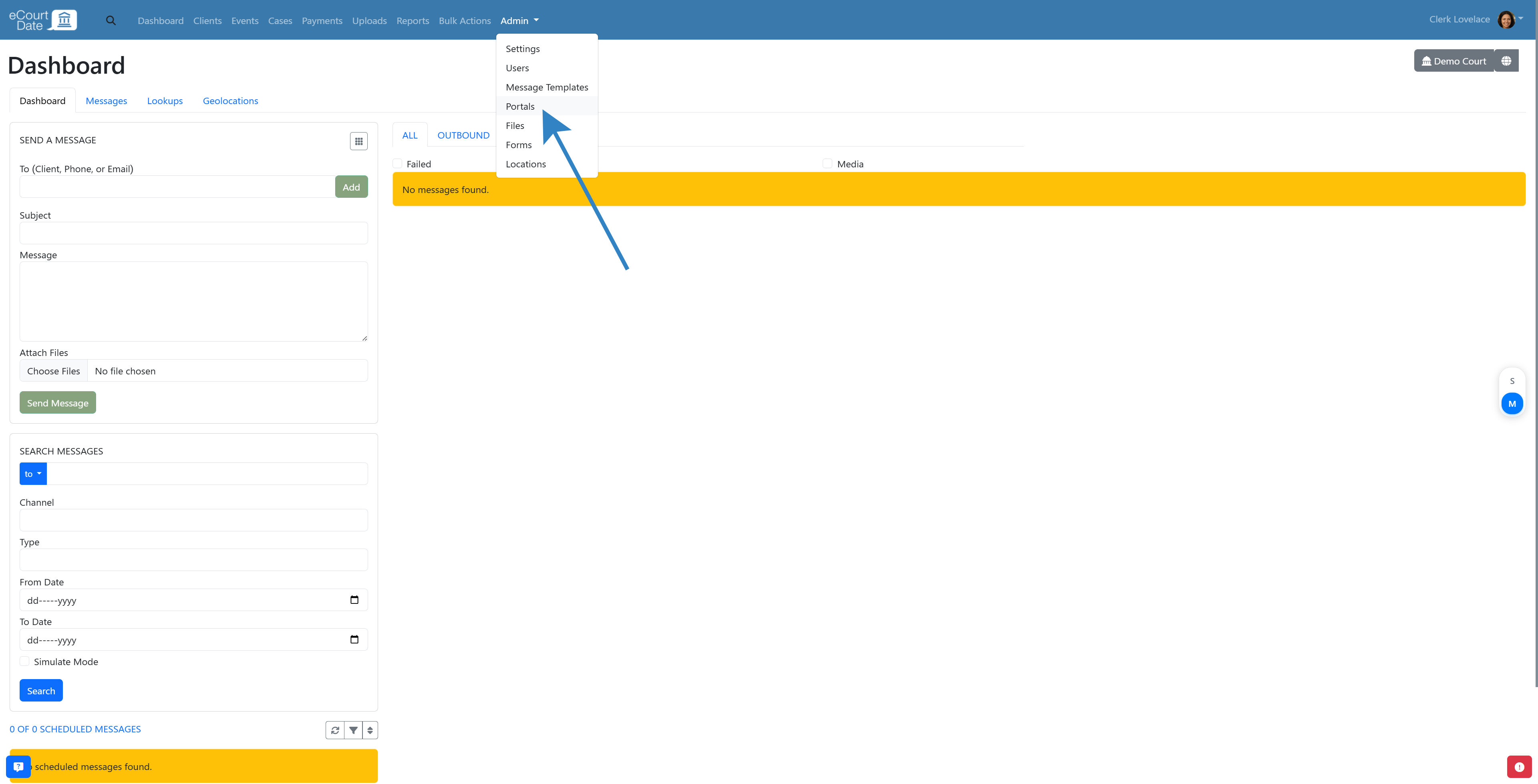
- Go to Admin > Portals.
- Enter a name in Portal Name in the Create Portal card. The subdomain is generated from the name as you type.
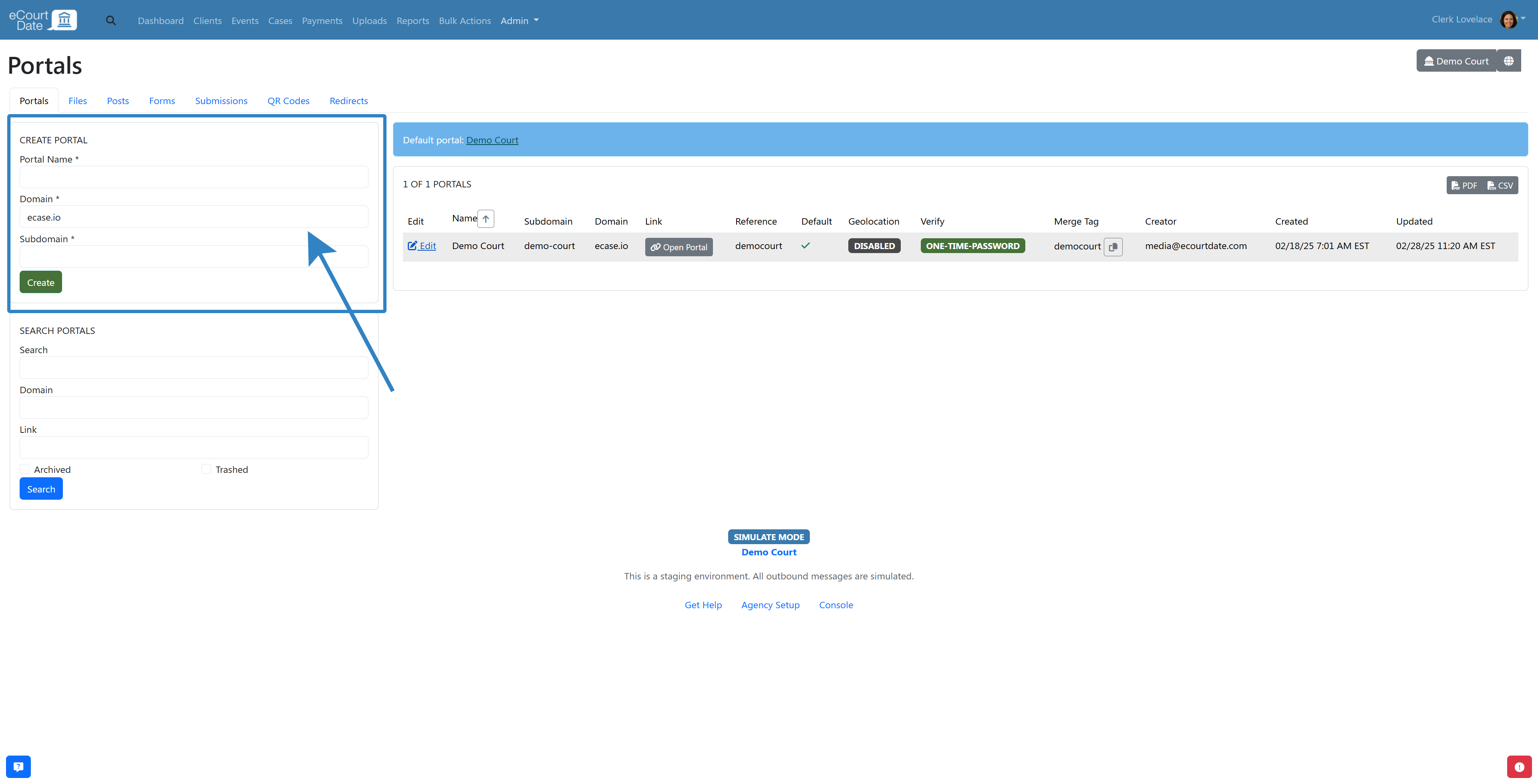
- Select a Domain.
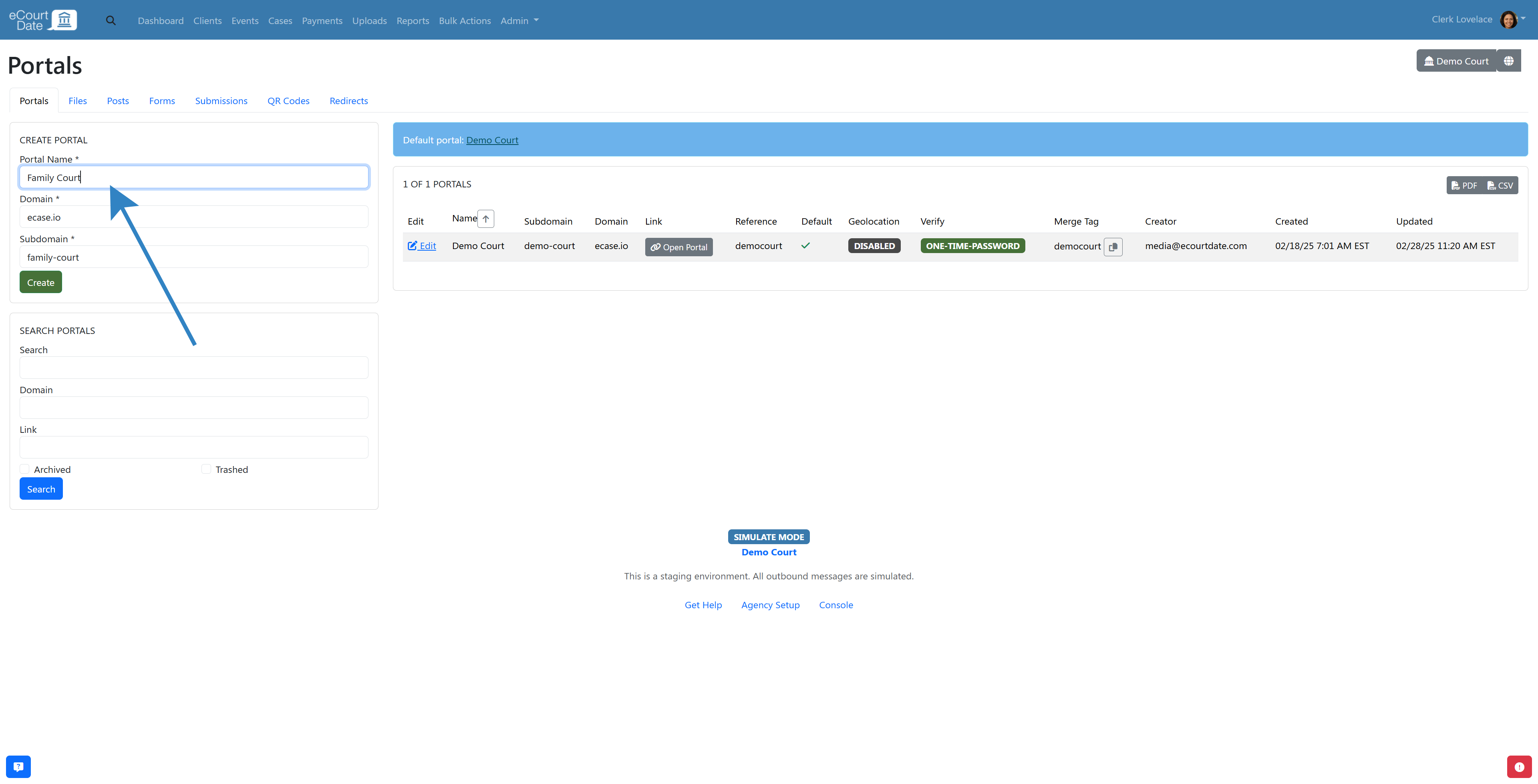
- Edit the Subdomain if you left the domain set to
ecase.io.
- Click Create to open the new portal in the editor.
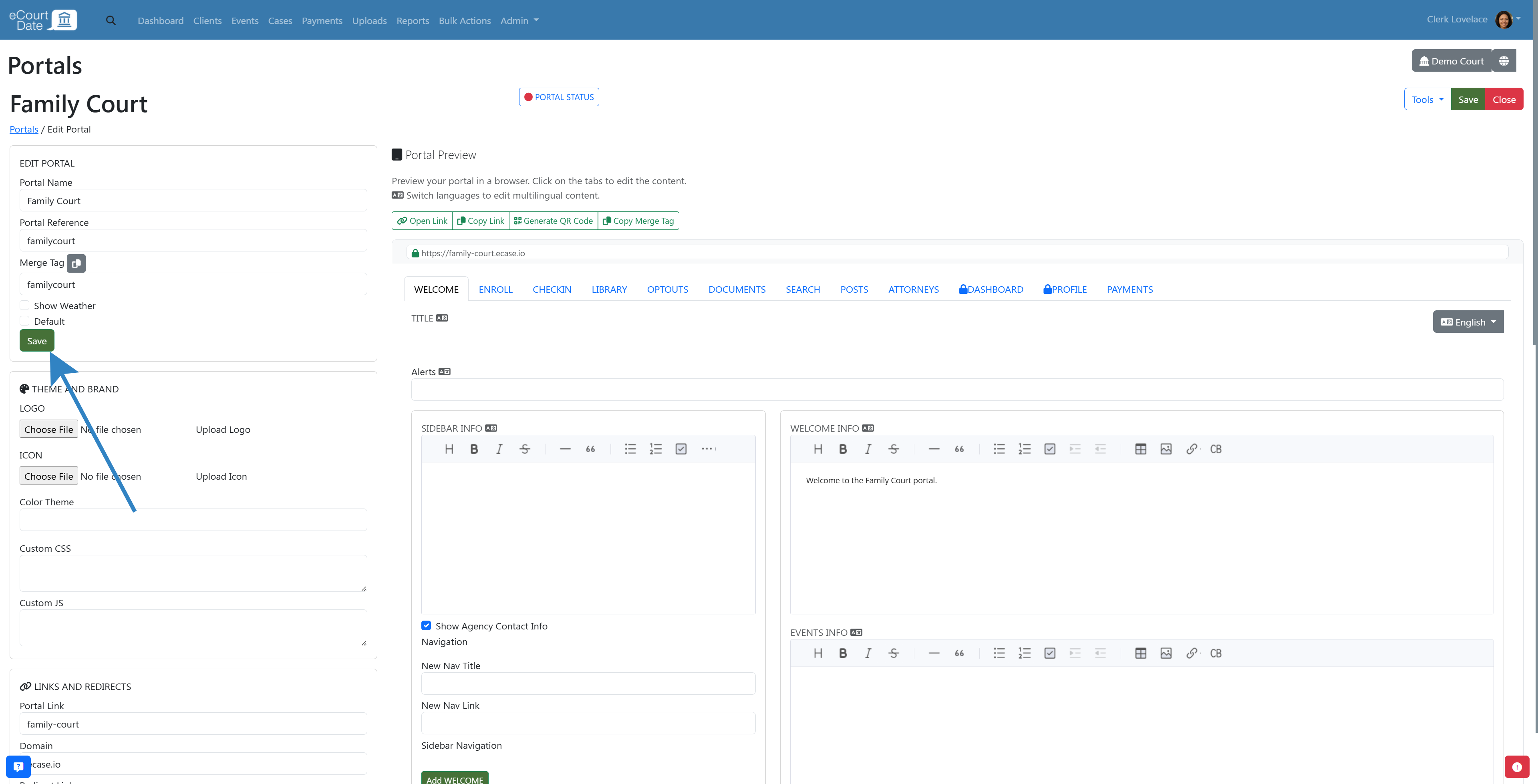
- Review the Edit Portal card and set Merge Tag, plus the Default checkbox if this portal should be your agency default.
- Brand the portal in Theme and Brand.
- Click Upload Logo and Upload Icon to add your artwork.
- Click one of the Color Theme cards (Classic Blue, Forest Green, Sunset Orange, Royal Purple, Crimson Red, Midnight Dark, Ocean Teal, or Golden Yellow).
- Add Custom CSS or Custom JS only if you need styling beyond the themes.
- Confirm the addressing in Links and Redirects, where you can set Portal Link, Domain, Redirect Link, Virtual Link, and Virtual Code.
- Set access rules in Tracking and Authentication.
- Select Geolocation Tracking (
optional, required, or continuous, or leave it Disabled).
- Select Client Authentication.
- Select Supervision Monitoring if this portal serves supervised clients.
- Enter an Allowed Domain to restrict clients to email addresses on that domain.
- Select a Chatbot and a Chatbot Position if you want a chatbot on the portal.
- Enter your profile links under Social Media (Facebook URL, Twitter/X URL, Instagram URL, LinkedIn URL, YouTube URL, and TikTok URL).
- Drag files onto the Upload Media dropzone to host images and documents on the portal, then click Copy URL to reference one in your content.
- Click a tab in Portal Preview to open the editor for that page. Welcome holds Welcome Info, Events Info, and Terms and Conditions, while the other tabs hold their own settings such as Library Description, Check-In Settings, Opt-Outs, Enroll Form, Client Profile, Photos, Tasks, Organizations, Case Search, Posts, and Documents.
- Select a language from the dropdown above the preview to edit that language, then click Auto Translate to translate the welcome content into it.
- Build the portal menu from the Sidebar Info card by entering a New Nav Title and New Nav Link and clicking Add Navigation, then setting each entry to Make Public or Make Private.
- Click Save at the top of the page.
- Click View Portal above the preview to open the live portal in a new tab.
What to Expect
Clicking Create takes you straight to the editor for the new portal. If your agency has no default portal yet, the portal you just created becomes the default.
Some controls save the moment you change them, including the Color Theme cards, Geolocation Tracking, Client Authentication, Supervision Monitoring, Custom CSS, Custom JS, and the social media URLs. Text you type into fields such as Portal Name, Portal Link, and Whitelist Domains is written when you click Save.
The Portal Status button at the top of the editor shows a green dot when the portal responds and a red dot when it does not. The address bar above Portal Preview always shows the exact URL of the tab you are editing.
Back on the Portals page, the portal appears in the table with its Name, Subdomain, Domain, Reference, Default, Geolocation, Verify, and Merge Tag columns, plus an Open Portal button.
Best Practices
- Upload a logo and an icon before you share the portal, since both appear to every visitor.
- Pick a Color Theme rather than writing Custom CSS, and keep custom code for the few rules a theme cannot cover.
- Enable only the tabs your clients actually need, so the portal stays short and obvious to navigate.
- Set the multilingual fields for every language your agency serves, then check each one by switching the language dropdown.
- Copy the Merge Tag and use it in message templates instead of pasting the raw URL, so the link keeps working if the domain changes.
- Keep anything sensitive out of Upload Media, because files uploaded there are publicly accessible to anyone on the internet.
Frequently Asked Questions
Q: How do I share a link to one specific portal page?
A: Click that page tab in Portal Preview first. The address bar above the preview updates to the page URL, and Copy Link copies that exact address.
Q: Where do I create a QR code for my portal?
A: Click Generate QR Code above Portal Preview to open the Design Studio in a new tab. You can also reach it from the Design Studio tab on the Portals tab strip.
Q: Why do some tabs in the preview have a padlock?
A: The padlock marks pages that only signed-in clients can reach: Dashboard, Profile, Photos, Tasks, Organizations, and Interpreters. Everything before the divider is public.
Q: Can I limit who is allowed to enroll or sign in?
A: Yes. Enter a domain such as agency.gov in Allowed Domain under Tracking and Authentication. Clients can then only use an email address on that domain to enroll or log in.
Q: Can I use our agency domain instead of ecase.io?
A: Yes. Add the domain to your agency first, then select it under Domain. The Subdomain field only appears while the domain is set to ecase.io.
Q: Can I put the portal inside our existing website?
A: Yes. Copy the iFrame Embed Code from the Embed and Share card, and list the sites that are allowed to embed it under Whitelist Domains.
Troubleshooting
Issue: A change you made is not showing on the live portal.
Symptoms: The portal opens normally, but it still shows the old content or the old colors.
Solution: Click Save at the top of the editor. Fields such as Portal Name, Portal Link, and the sidebar text are only written when you save, unlike the dropdowns that save on change.
Issue: The Portal Status button shows a red dot.
Symptoms: A red circle appears next to Portal Status, and the portal address does not load.
Solution: Check Portal Link and Domain in the Links and Redirects card. If you are on a custom domain, confirm the DNS records for that domain are in place, since DNS changes can take a day or two to propagate.
Issue: The Subdomain field is missing from the Create Portal card.
Symptoms: The card shows only Portal Name and Domain.
Solution: Subdomain appears only while Domain is set to ecase.io. A custom domain already carries its own subdomain, so there is nothing to enter.
Issue: The Portals page shows "No default portal found."
Symptoms: A warning banner sits above the portals table.
Solution: Open the portal you want as the default, tick Default in the Edit Portal card, and click Save.
Issue: The Chatbot card says no chatbots were found.
Symptoms: An information alert appears instead of a list of chatbots in the dropdown.
Solution: Create a chatbot under Admin > Automations > Chatbots first, then return to the portal and select it.
Related Articles
A web portal is a public website your agency owns where clients can enroll for notifications, check in, look up a case, and manage their own profile. You create a portal from **Admin** > **Portals**, then build out every page of it inside the portal editor.
### Overview
Each portal lives on a subdomain of `ecase.io` or on a custom domain your agency has added. The portal editor is split into two halves. The left column holds configuration cards (**Edit Portal**, **Theme and Brand**, **Links and Redirects**, **Tracking and Authentication**, **Chatbot**, **Social Media**, **Upload Media**, and **Embed and Share**). The right side is **Portal Preview**, a live mock browser where you click a tab to edit the content of that page.
**Portal Preview** separates public pages from client-only pages. The public tabs are **Welcome**, **Enroll**, **Checkin**, **Library**, **Optouts**, **Documents**, **Search**, and **Posts**. After a divider, the client-only tabs each carry a padlock icon: **Dashboard**, **Profile**, **Photos**, **Tasks**, **Organizations**, and **Interpreters**. A visitor must sign in before any padlocked page is reachable.
Content fields marked with a language icon are multilingual. Switch the language from the dropdown above the preview and the field shows the value for that language, so one portal can serve every language your agency supports.
### Prerequisites
- The `create_portals` and `update_portals` permissions
- Access to the **Admin** menu in the top navigation
- A logo file and an icon file if you want to brand the portal
- A custom domain already added to your agency if you do not want to use `ecase.io`
- A chatbot created under **Admin** > **Automations** > **Chatbots** if you want to embed one
### How-To Steps
1. Go to **Admin** > **Portals**.
2. Enter a name in **Portal Name** in the **Create Portal** card. The subdomain is generated from the name as you type.
3. Select a **Domain**.
4. Edit the **Subdomain** if you left the domain set to `ecase.io`.
5. Click **Create** to open the new portal in the editor.
6. Review the **Edit Portal** card and set **Merge Tag**, plus the **Default** checkbox if this portal should be your agency default.
7. Brand the portal in **Theme and Brand**.
- Click **Upload Logo** and **Upload Icon** to add your artwork.
- Click one of the **Color Theme** cards (**Classic Blue**, **Forest Green**, **Sunset Orange**, **Royal Purple**, **Crimson Red**, **Midnight Dark**, **Ocean Teal**, or **Golden Yellow**).
- Add **Custom CSS** or **Custom JS** only if you need styling beyond the themes.
8. Confirm the addressing in **Links and Redirects**, where you can set **Portal Link**, **Domain**, **Redirect Link**, **Virtual Link**, and **Virtual Code**.
9. Set access rules in **Tracking and Authentication**.
- Select **Geolocation Tracking** (`optional`, `required`, or `continuous`, or leave it **Disabled**).
- Select **Client Authentication**.
- Select **Supervision Monitoring** if this portal serves supervised clients.
- Enter an **Allowed Domain** to restrict clients to email addresses on that domain.
10. Select a **Chatbot** and a **Chatbot Position** if you want a chatbot on the portal.
11. Enter your profile links under **Social Media** (**Facebook URL**, **Twitter/X URL**, **Instagram URL**, **LinkedIn URL**, **YouTube URL**, and **TikTok URL**).
12. Drag files onto the **Upload Media** dropzone to host images and documents on the portal, then click **Copy URL** to reference one in your content.
13. Click a tab in **Portal Preview** to open the editor for that page. **Welcome** holds **Welcome Info**, **Events Info**, and **Terms and Conditions**, while the other tabs hold their own settings such as **Library Description**, **Check-In Settings**, **Opt-Outs**, **Enroll Form**, **Client Profile**, **Photos**, **Tasks**, **Organizations**, **Case Search**, **Posts**, and **Documents**.
14. Select a language from the dropdown above the preview to edit that language, then click **Auto Translate** to translate the welcome content into it.
15. Build the portal menu from the **Sidebar Info** card by entering a **New Nav Title** and **New Nav Link** and clicking **Add Navigation**, then setting each entry to **Make Public** or **Make Private**.
16. Click **Save** at the top of the page.
17. Click **View Portal** above the preview to open the live portal in a new tab.
### What to Expect
Clicking **Create** takes you straight to the editor for the new portal. If your agency has no default portal yet, the portal you just created becomes the default.
Some controls save the moment you change them, including the **Color Theme** cards, **Geolocation Tracking**, **Client Authentication**, **Supervision Monitoring**, **Custom CSS**, **Custom JS**, and the social media URLs. Text you type into fields such as **Portal Name**, **Portal Link**, and **Whitelist Domains** is written when you click **Save**.
The **Portal Status** button at the top of the editor shows a green dot when the portal responds and a red dot when it does not. The address bar above **Portal Preview** always shows the exact URL of the tab you are editing.
Back on the **Portals** page, the portal appears in the table with its **Name**, **Subdomain**, **Domain**, **Reference**, **Default**, **Geolocation**, **Verify**, and **Merge Tag** columns, plus an **Open Portal** button.
### Best Practices
- Upload a logo and an icon before you share the portal, since both appear to every visitor.
- Pick a **Color Theme** rather than writing **Custom CSS**, and keep custom code for the few rules a theme cannot cover.
- Enable only the tabs your clients actually need, so the portal stays short and obvious to navigate.
- Set the multilingual fields for every language your agency serves, then check each one by switching the language dropdown.
- Copy the **Merge Tag** and use it in message templates instead of pasting the raw URL, so the link keeps working if the domain changes.
- Keep anything sensitive out of **Upload Media**, because files uploaded there are publicly accessible to anyone on the internet.
### Frequently Asked Questions
**Q: How do I share a link to one specific portal page?**
A: Click that page tab in **Portal Preview** first. The address bar above the preview updates to the page URL, and **Copy Link** copies that exact address.
**Q: Where do I create a QR code for my portal?**
A: Click **Generate QR Code** above **Portal Preview** to open the **Design Studio** in a new tab. You can also reach it from the **Design Studio** tab on the **Portals** tab strip.
**Q: Why do some tabs in the preview have a padlock?**
A: The padlock marks pages that only signed-in clients can reach: **Dashboard**, **Profile**, **Photos**, **Tasks**, **Organizations**, and **Interpreters**. Everything before the divider is public.
**Q: Can I limit who is allowed to enroll or sign in?**
A: Yes. Enter a domain such as `agency.gov` in **Allowed Domain** under **Tracking and Authentication**. Clients can then only use an email address on that domain to enroll or log in.
**Q: Can I use our agency domain instead of ecase.io?**
A: Yes. Add the domain to your agency first, then select it under **Domain**. The **Subdomain** field only appears while the domain is set to `ecase.io`.
**Q: Can I put the portal inside our existing website?**
A: Yes. Copy the **iFrame Embed Code** from the **Embed and Share** card, and list the sites that are allowed to embed it under **Whitelist Domains**.
### Troubleshooting
**Issue:** A change you made is not showing on the live portal.
**Symptoms:** The portal opens normally, but it still shows the old content or the old colors.
**Solution:** Click **Save** at the top of the editor. Fields such as **Portal Name**, **Portal Link**, and the sidebar text are only written when you save, unlike the dropdowns that save on change.
**Issue:** The **Portal Status** button shows a red dot.
**Symptoms:** A red circle appears next to **Portal Status**, and the portal address does not load.
**Solution:** Check **Portal Link** and **Domain** in the **Links and Redirects** card. If you are on a custom domain, confirm the DNS records for that domain are in place, since DNS changes can take a day or two to propagate.
**Issue:** The **Subdomain** field is missing from the **Create Portal** card.
**Symptoms:** The card shows only **Portal Name** and **Domain**.
**Solution:** **Subdomain** appears only while **Domain** is set to `ecase.io`. A custom domain already carries its own subdomain, so there is nothing to enter.
**Issue:** The **Portals** page shows "No default portal found."
**Symptoms:** A warning banner sits above the portals table.
**Solution:** Open the portal you want as the default, tick **Default** in the **Edit Portal** card, and click **Save**.
**Issue:** The **Chatbot** card says no chatbots were found.
**Symptoms:** An information alert appears instead of a list of chatbots in the dropdown.
**Solution:** Create a chatbot under **Admin** > **Automations** > **Chatbots** first, then return to the portal and select it.
### Related Articles
- [How to Allow Clients to Login to a Portal](/how-to-allow-clients-to-login-to-a-portal)
- [How to Setup a Self-Enroll Form](/how-to-setup-a-self-enroll-form)
- [How to Manage Portal Check-ins](/how-to-manage-portal-check-ins)
- [How to Track Geolocation on Portal Visits](/how-to-track-geolocation-on-portal-visits)
- [How to Create a Custom Domain](/how-to-create-a-custom-domain)
- [How to Create Informational Posts](/how-to-create-informational-posts)
- [How to generate qr codes](/how-to-generate-qr-codes)