Create, update, search, archive, trash, and restore client records in eCourtDate, and work with the cards on each client profile.
Clients are the people your agency sends messages to, and every contact, event, case, and payment in eCourtDate belongs to a client record. This guide covers creating, updating, searching, archiving, trashing, and restoring clients.
Overview
- What it is: The Clients page, where you create and search client records, and the client profile, where you edit a client and reach everything attached to them.
- Why it matters: Messages reach a client only through the contacts on their record, so accurate client data keeps your notifications going to the right people.
- Who uses it: Court clerks, probation officers, and any staff at your agency responsible for recipient data.
- Expected outcomes: A client list you can filter and export, and profiles that hold the contacts, tasks, photos, documents, and organizations tied to each person.
Prerequisites
- The
view_any_client permission to open the Clients page and search records
- The
create_clients permission to see the Create Client card
- The
update_clients permission to save profile changes, archive, and restore
- The
trash_clients permission to trash a client
- Client statuses set up under Admin > Settings > Statuses if you want to use the Status field (optional)
How-To Steps
Create a Client
- Click Clients in the navigation.
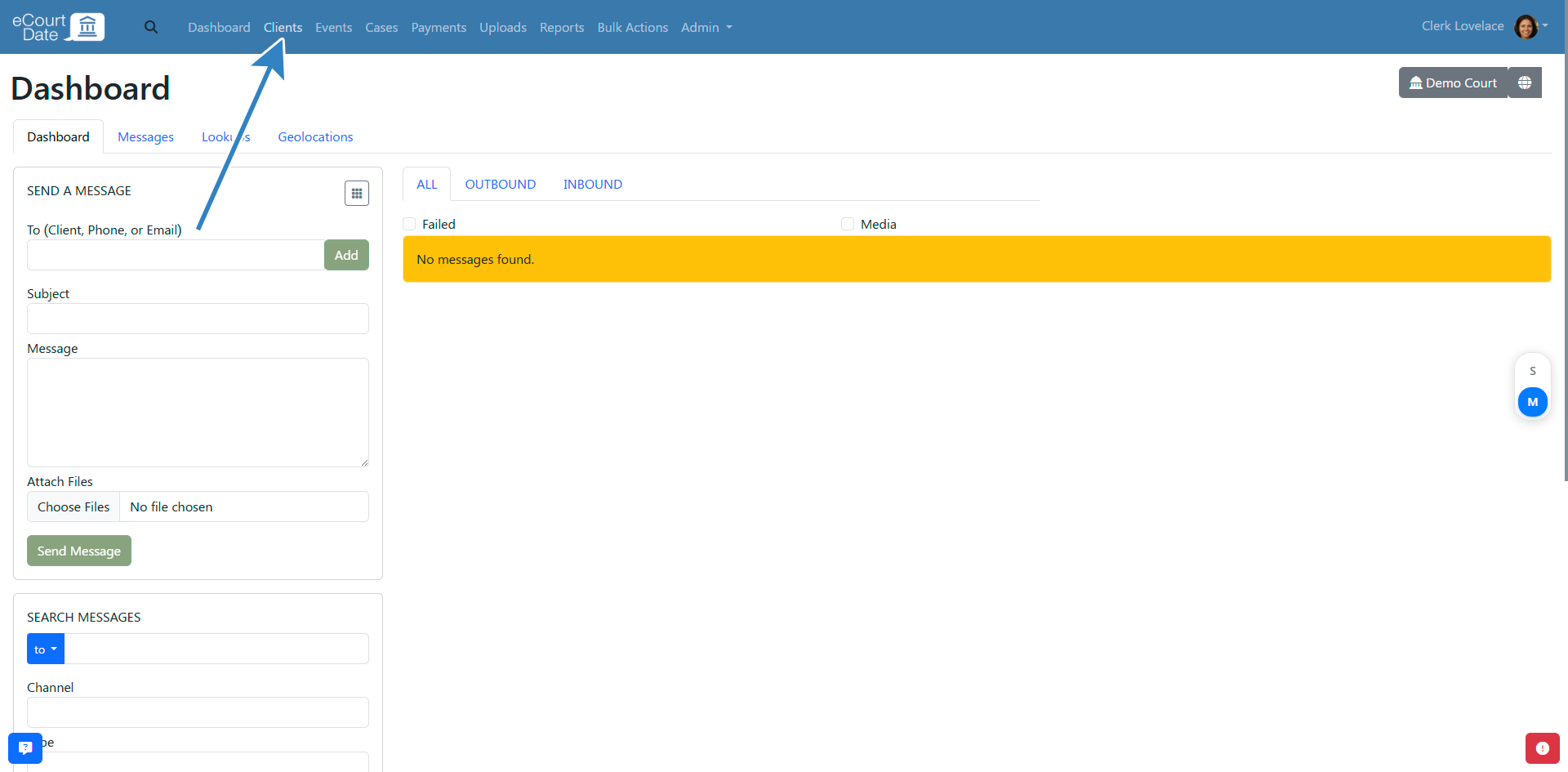
- Click Fields on the Create Client card to show or hide fields (optional).
- Enter the client's details in the Create Client card.
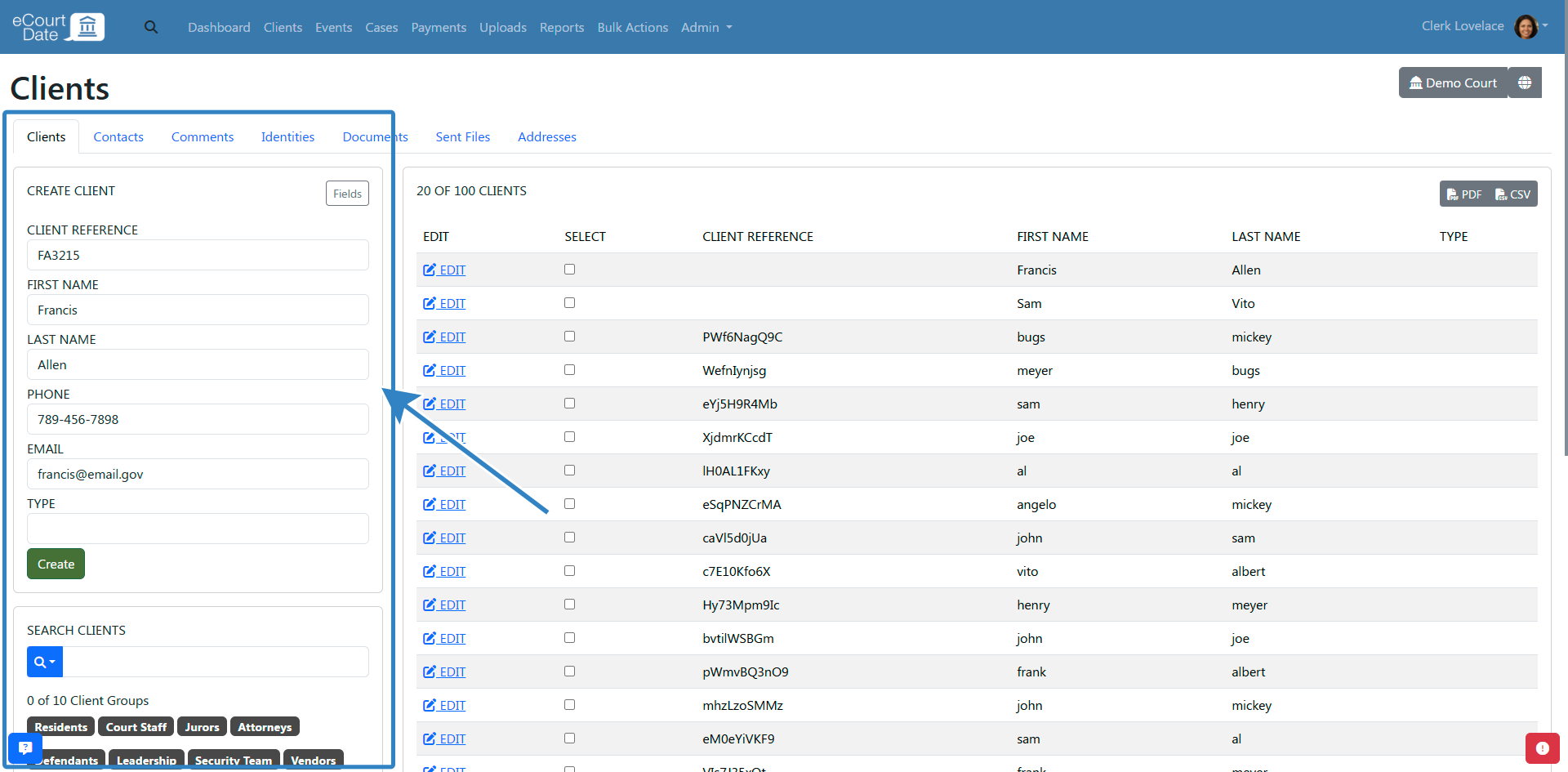
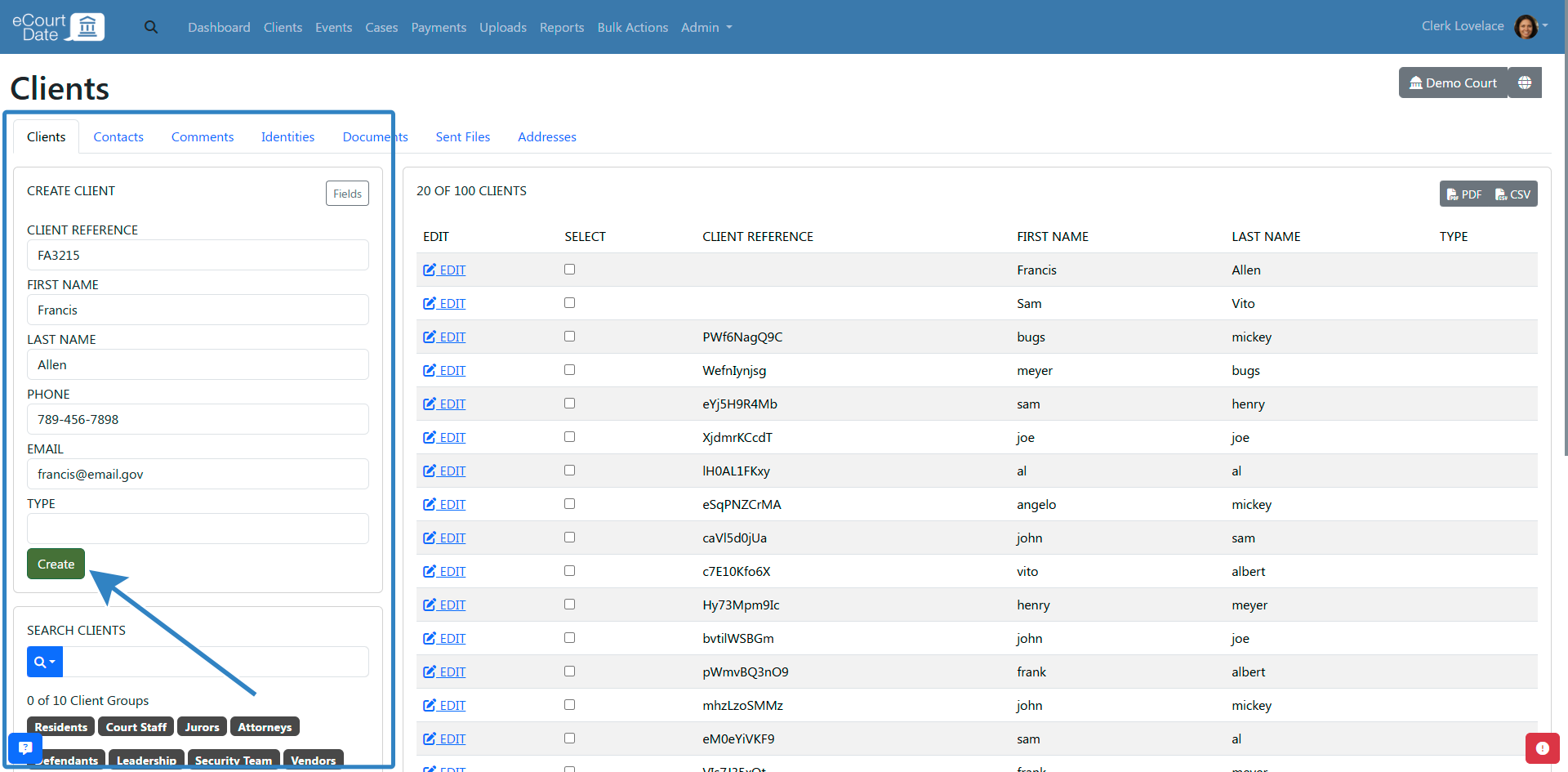
- Click Create.
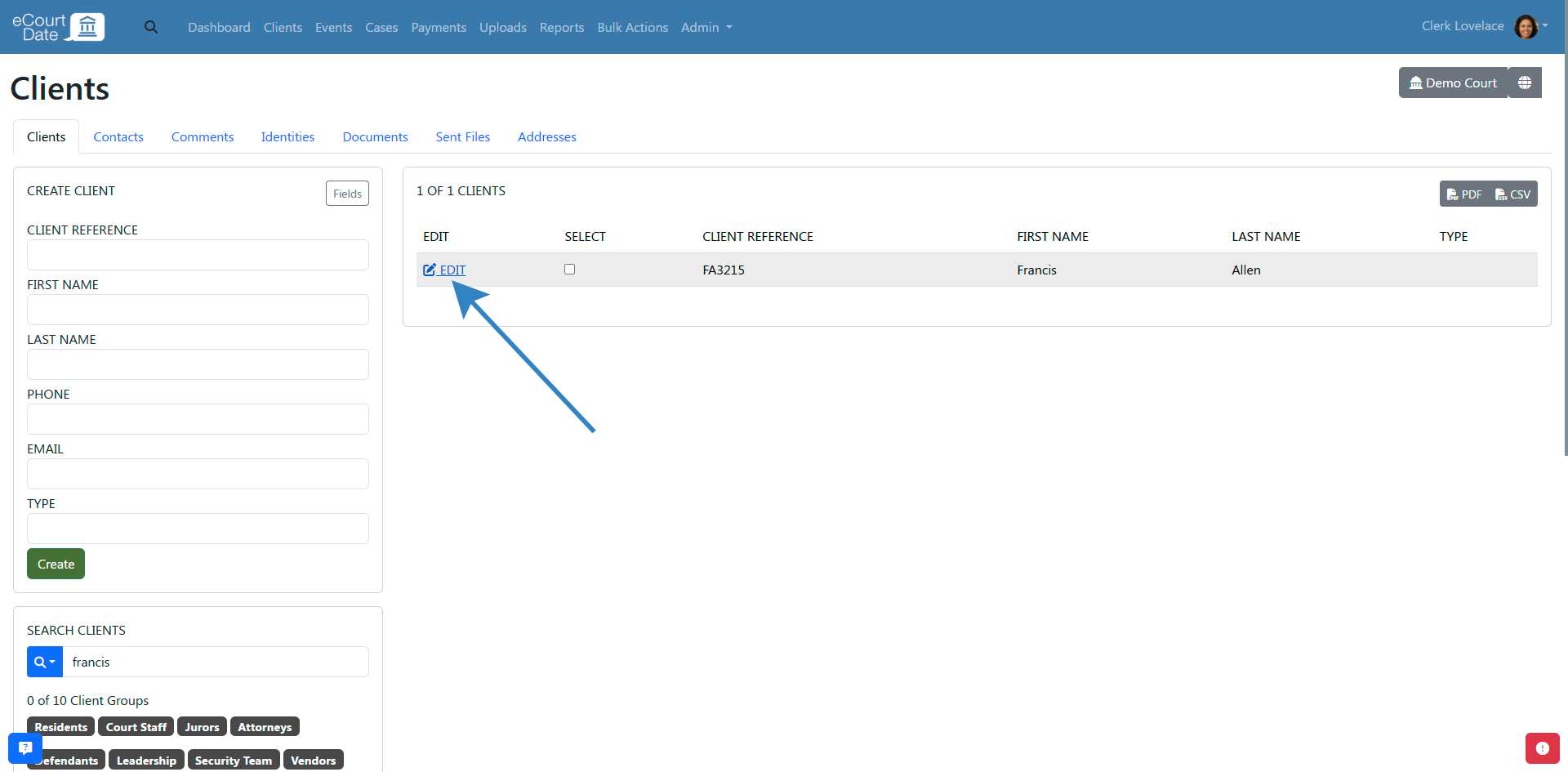
- Click the edit icon in the EDIT column of the new row to open the client's profile.
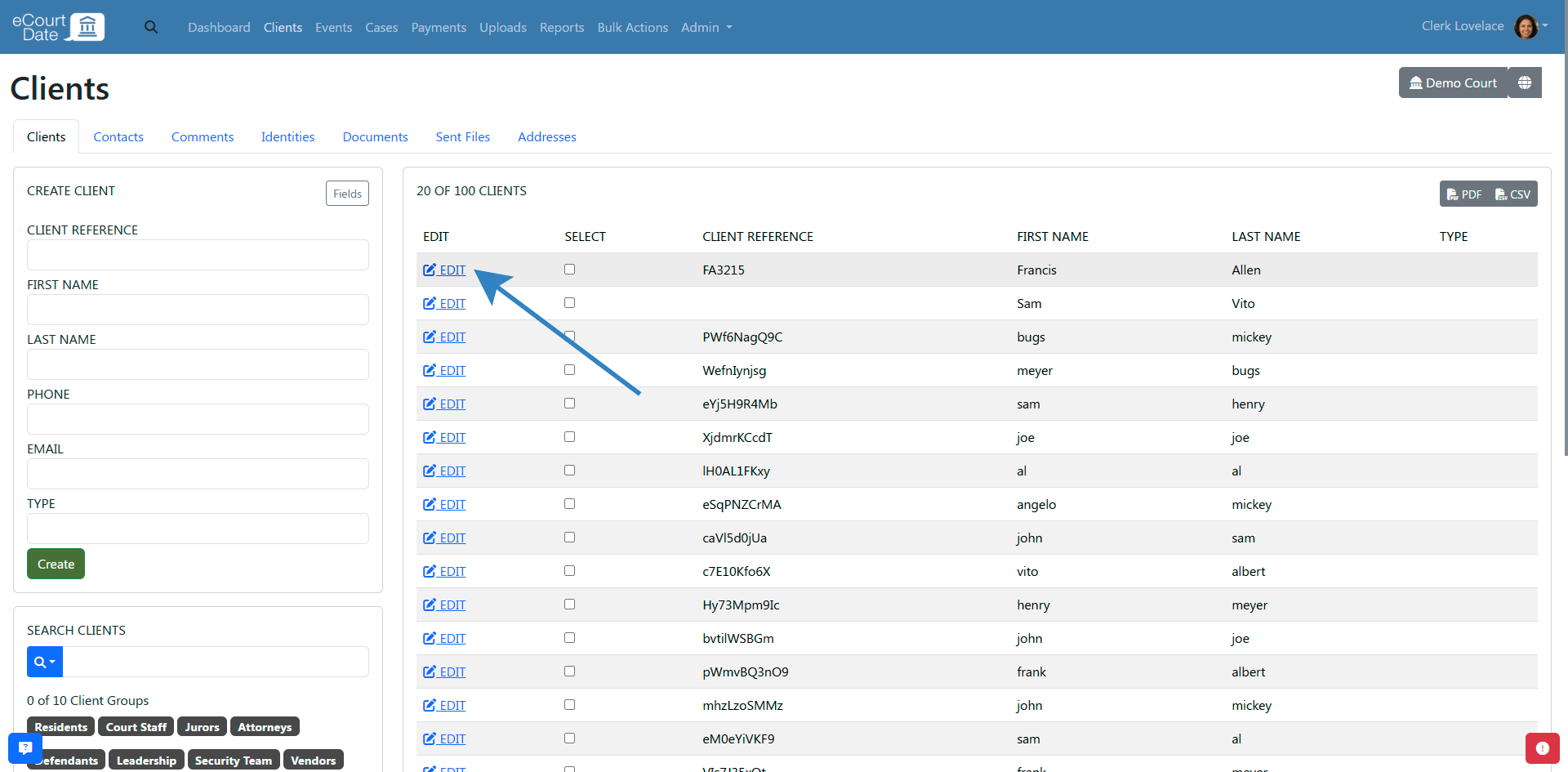
The Create Client card appears only when your role carries the create_clients permission. An alert confirms the client was added, and the new record appears at the top of the results list.
Update a Client
- Open the client's profile from the EDIT column on the Clients page.
- Change the fields you need in the Edit Client card.
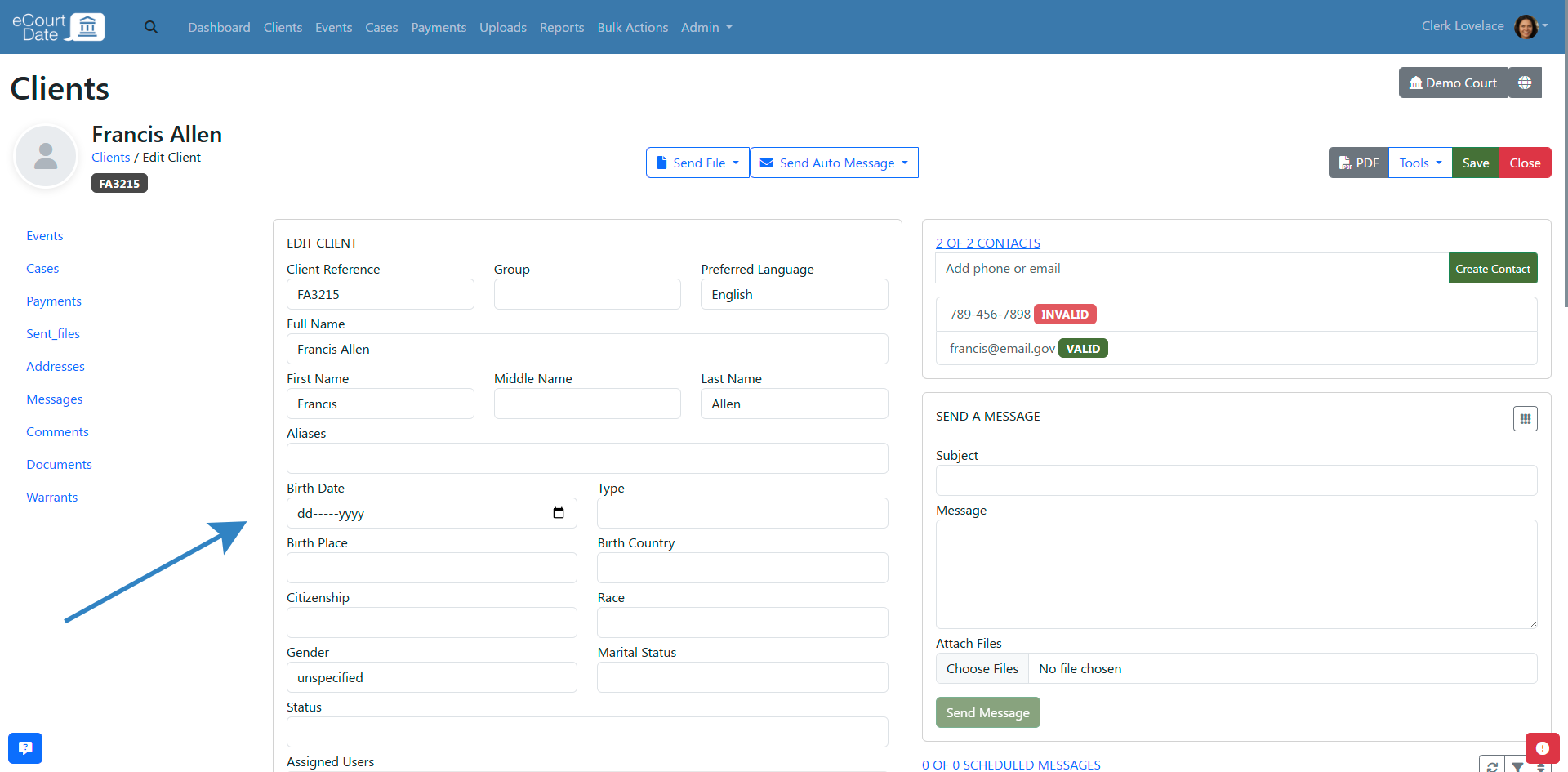
- Click Save.
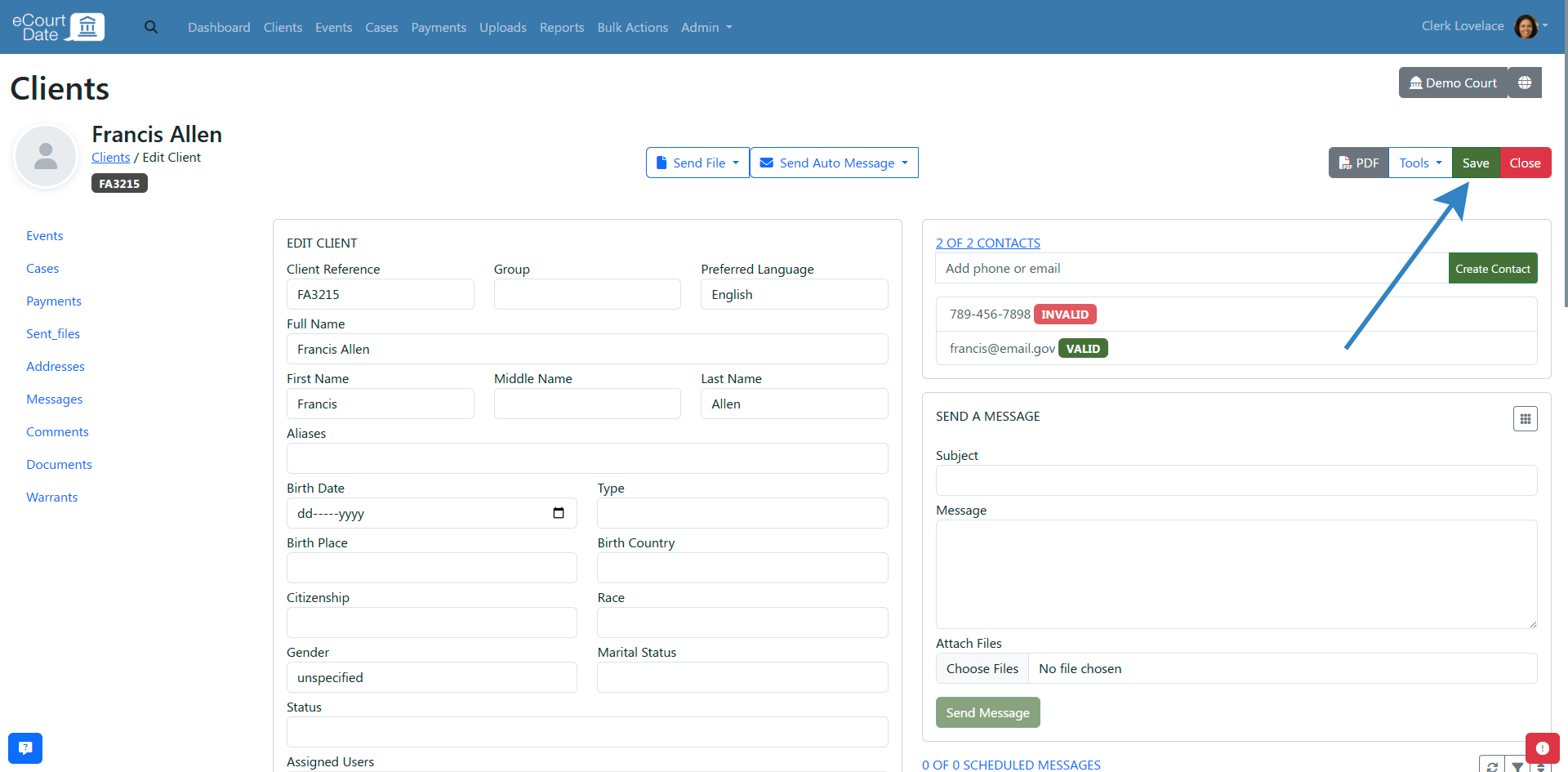
The Edit Client card holds Client Reference, Group, Preferred Language, Full Name, First Name, Middle Name, Last Name, Aliases, Type, Birth Date, Birth Place, Birth Country, Citizenship, Race, Gender, Marital Status, Status, Assigned Users, and Notes.
The Group field saves as soon as you pick a value, so you do not need to click Save after changing it.
Search for a Client
Two searches find clients.
Quick search in the navigation
- Click the search icon next to the logo.
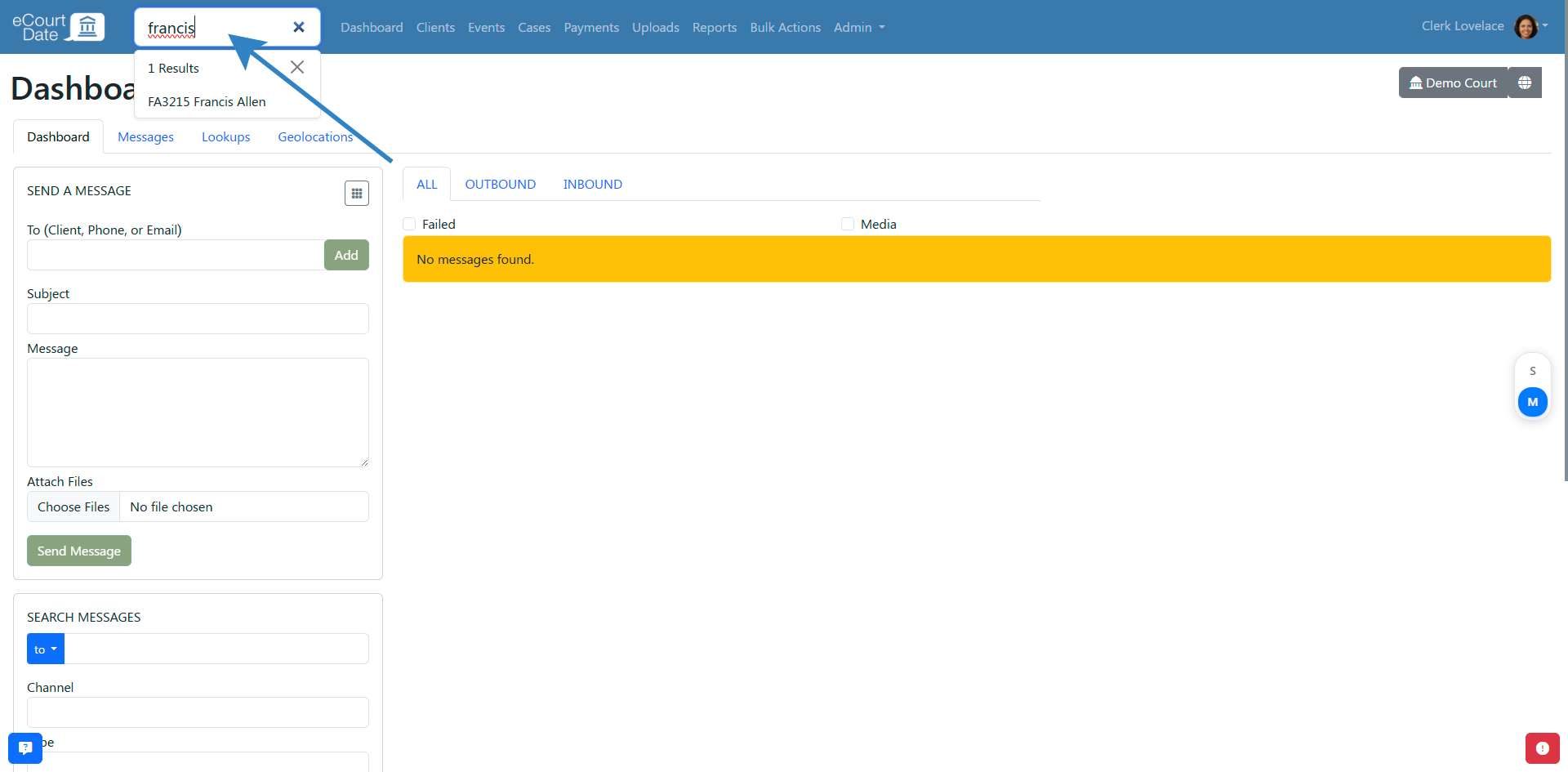
- Enter part of a first name, middle name, last name, full name, client reference, phone number, email address, case number, or event reference.
- Click a result to open that client.
Quick search skips archived and trashed clients.
Search Clients card
- Click Clients in the navigation.
- Enter your term in the search box on the Search Clients card.
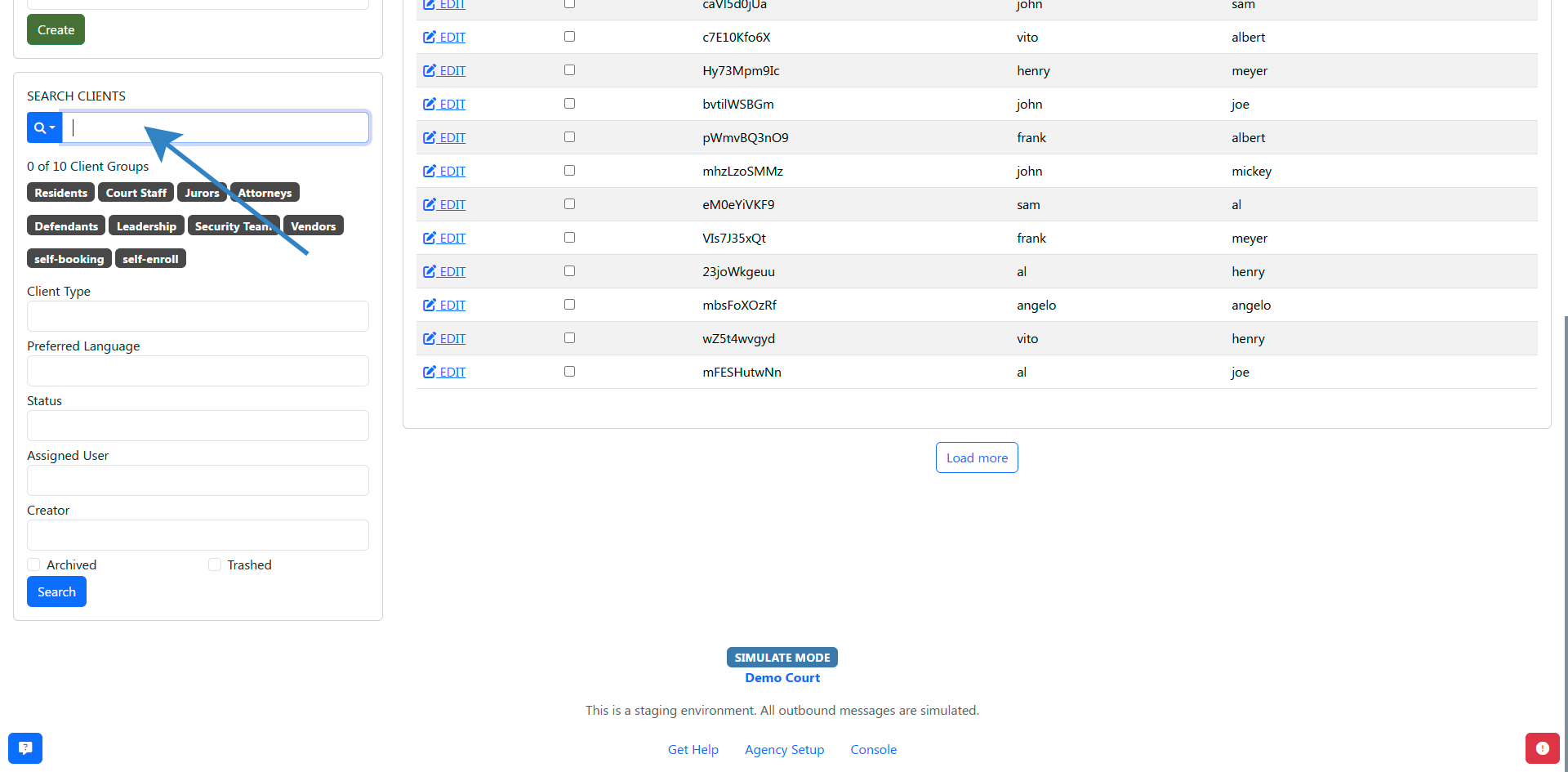
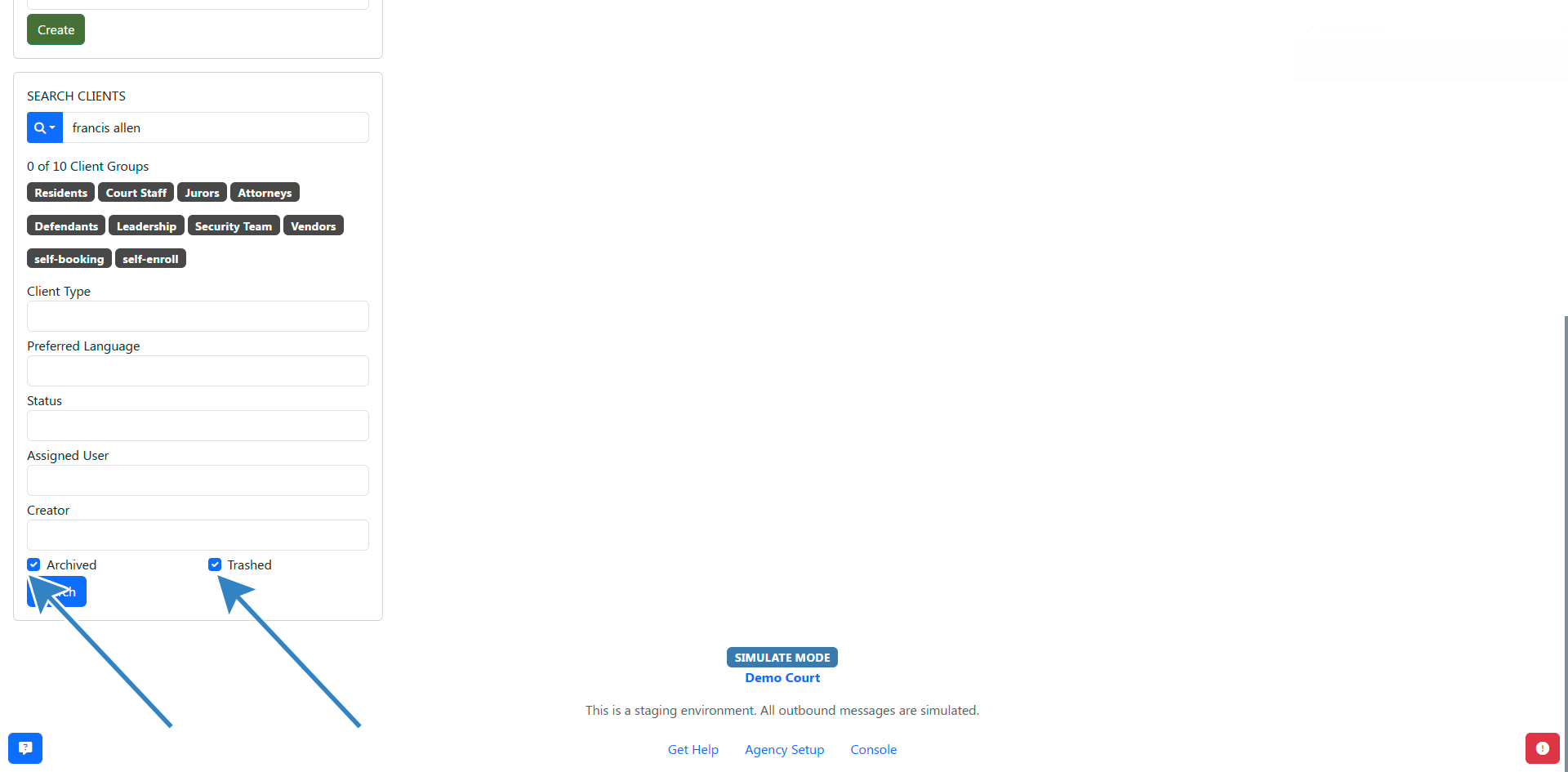
- Click the dropdown to the left of the search box and select First name, Last name, Middle name, Name, Client reference, Group, Aliases, or Type to search that one field (optional). Default searches first name, last name, and client reference together.
- Click the group and organization badges above the filters to limit results to those groups or organizations (optional).
- Narrow further with Type, Status, Assigned Users, Preferred Language, Date of Birth, and Creator (optional).
- Select Archived or Trashed to look at removed records (optional).
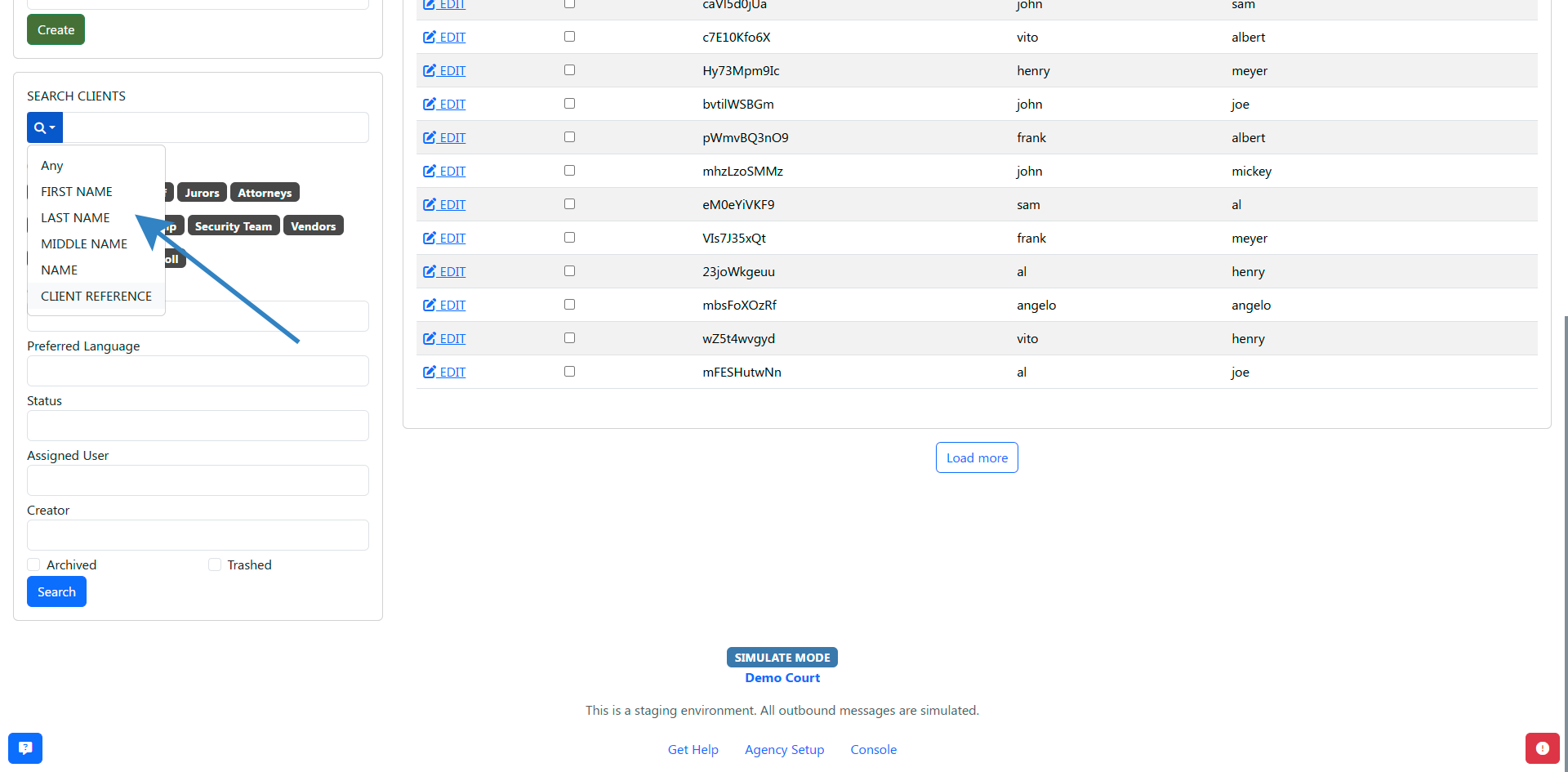
- Click Search.
The results card counts the records it loaded out of the total, offers PDF and CSV downloads, and shows a Load more button while more records remain. Click the view icon in the VIEW column to open a client summary above the table without leaving the page.
Archive, Trash, or Restore a Client
- Open the client's profile.
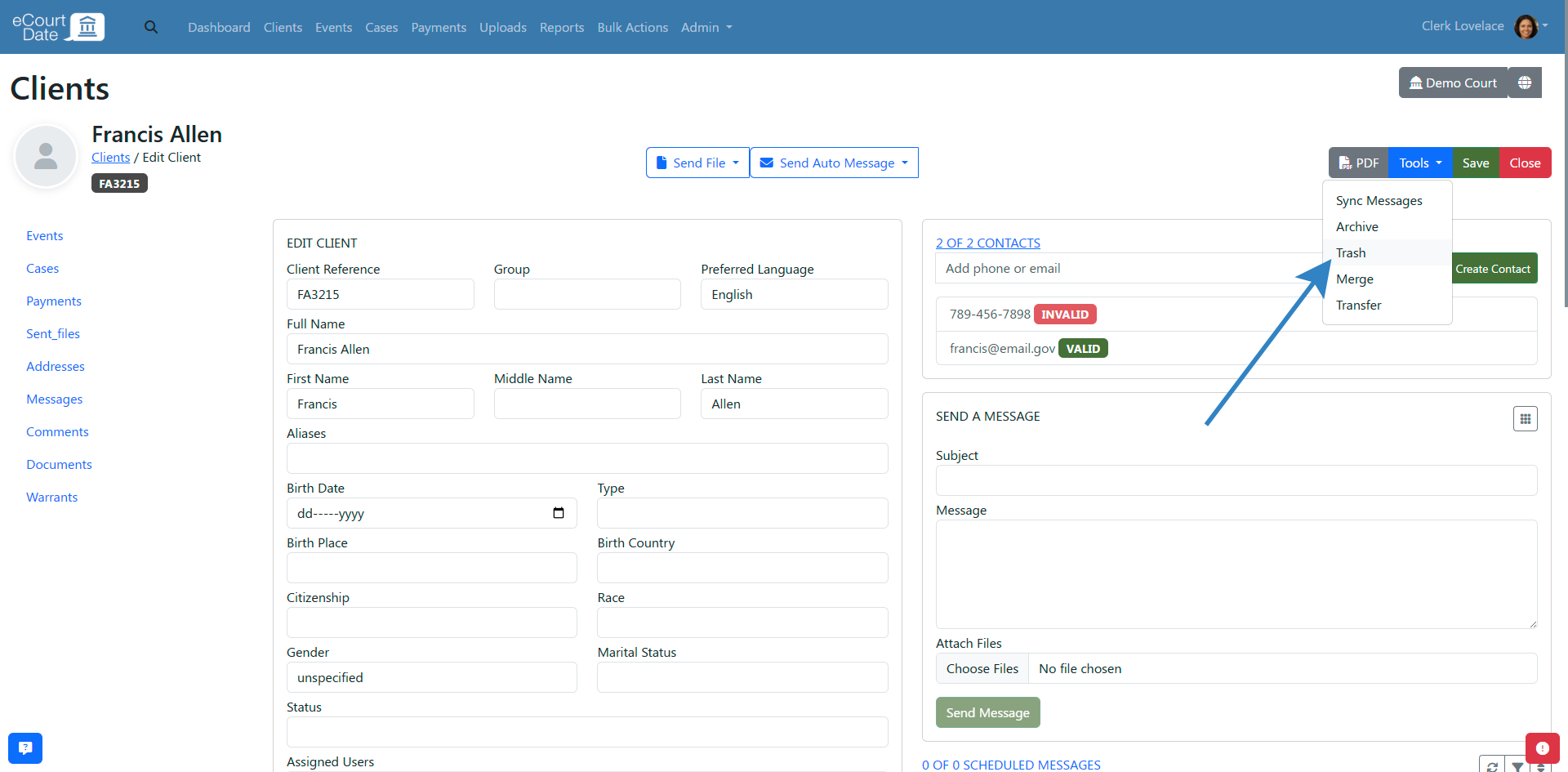
- Click Tools.
- Click Archive, Trash, or Restore.
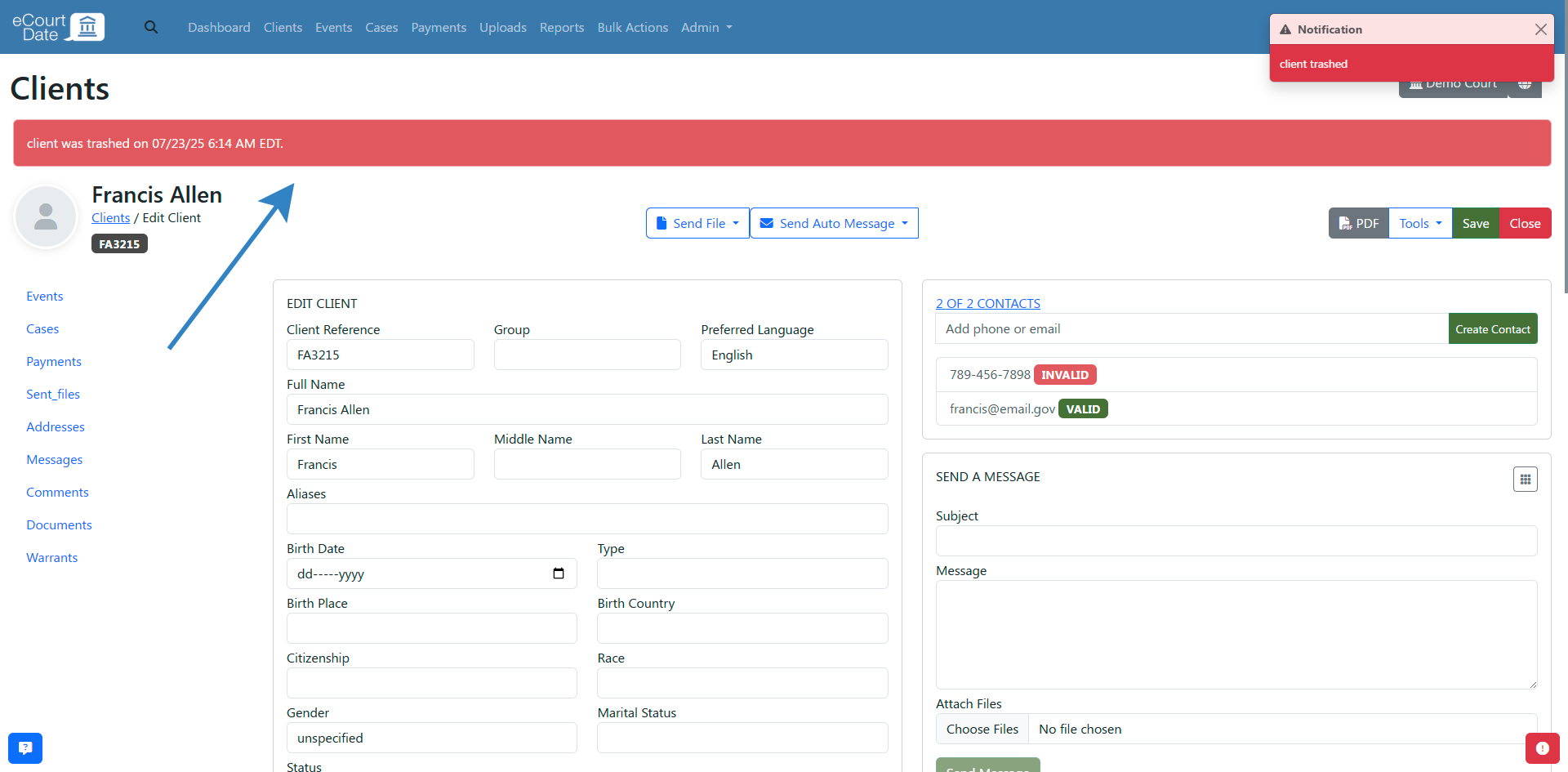
Restore appears only on a client that is already archived or trashed. To find one, select the Archived or Trashed checkbox on the Search Clients card before you click Search.
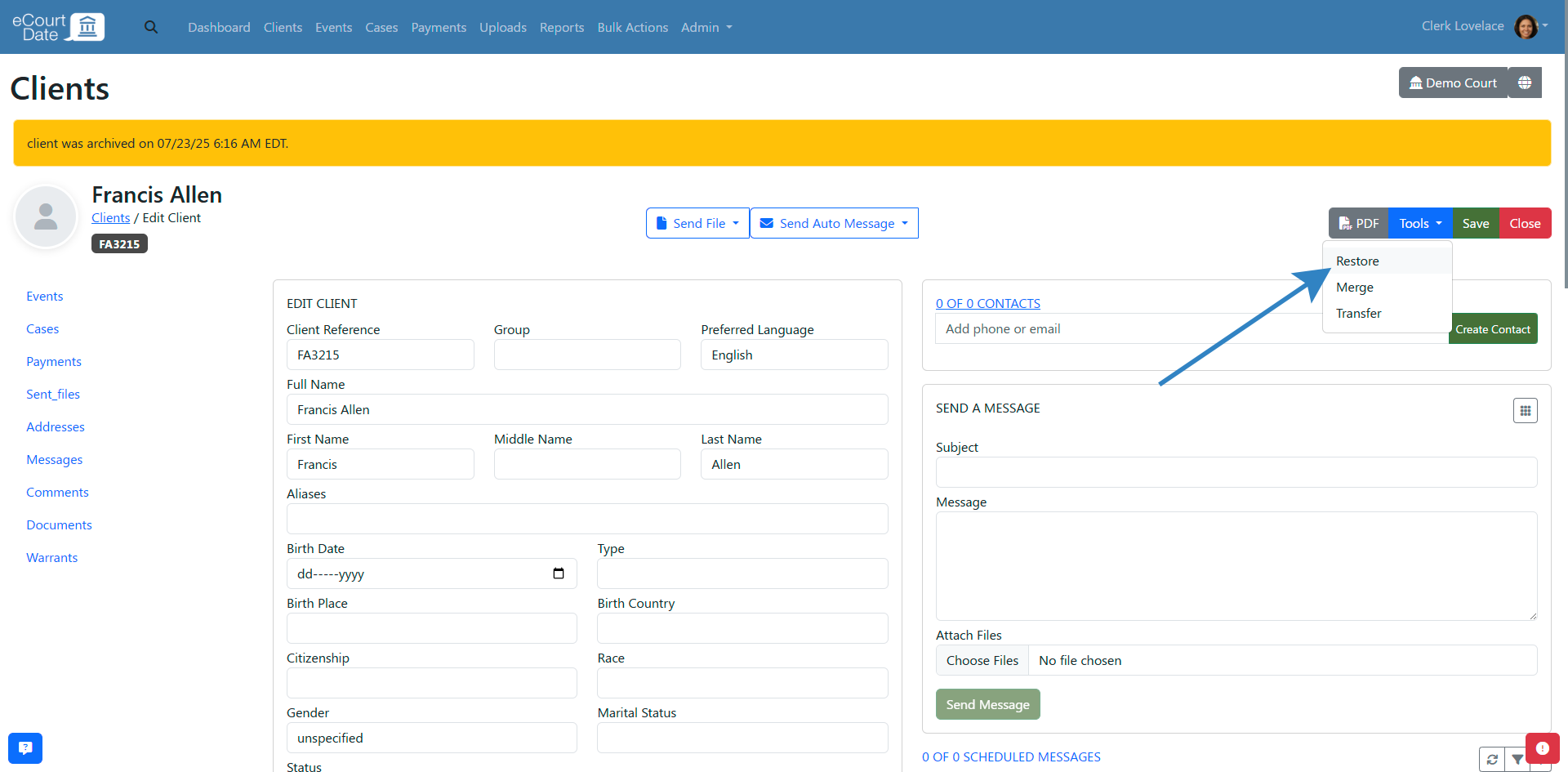
Archiving or trashing a client also archives or trashes their events, contacts, and cases, trashes their unsent messages, and removes their upcoming scheduled messages. An alert at the top of the profile names the date and time the client was archived or trashed, and stays there until you restore the record.
Restoring brings back all of the client's events, contacts, and cases that have not been permanently deleted, including ones you archived or trashed separately beforehand, and queues a resync of the client's upcoming events and payments. Scheduled messages removed when you archived or trashed the client are not restored.
Archive, Trash, or Restore Clients in Bulk
- Click Clients in the navigation.
- Search for the clients you want to change.
- Select the checkbox in the SELECT column for each client, or click Select All.
- Click Archive, Trash, or Restore.
- Click Confirm.
Restore replaces Archive and Trash while you are viewing archived or trashed results.
Work with the Client Profile
These cards sit on the profile itself:
- Manage Contacts: enter a value in the Add phone or email field and click Create Contact.
- Photos: click Upload Photos to add images, or click the photo at the top of the profile. The same card lists the client's documents with a link to open all of them.
- Assigned Tasks: click the plus button, enter a New Task and a Due Date, then click Create Task. Click View all tasks to open the full list.
- Choose Organizations: select an organization in Assign Organization and click Assign. Click the trash button next to an assigned organization to unassign it.
- Send a Message, Scheduled Messages, and Audit Logs: send a message to the client, review what is queued for them, and see who changed the record.
The left column of the profile links to Events, Cases, Tasks, Payments, Documents, Identities, Sent Files, Addresses, Comments, Warrants, and Citations. Each link opens that page filtered to the client.
Use the Other Client Tools
- Click Tools > Sync Messages to resync the client's messages. This option is hidden on an archived or trashed client.
- Click Tools > Merge to open Merge Client and combine two records.
- Click Tools > Transfer to open Transfer Client and send the client to another agency.
- Click PDF to download the profile.
- Click Send File or Send Auto Message to pick from your agency's files and auto messages. These buttons appear only when your agency has files or auto messages set up.
What to Expect
Creating and saving a client takes effect immediately, and an alert confirms each action. Archived and trashed clients drop out of quick search and out of the default results on the Clients page until you search with the Archived or Trashed checkbox. Trashed records are permanently deleted after the number of days set in Auto Delete Trashed Data under Admin > Settings, which defaults to 30 and accepts 1 to 180. Archived records stay until Auto Trash Archived Data moves them to the trash, and that setting defaults to never.
Best Practices
- Archive rather than trash a client you may need later. Trashed records are purged on the Auto Delete Trashed Data schedule, while archived records stay until your agency sets Auto Trash Archived Data.
- Pick a specific search field for common names. Default searches first name, last name, and client reference at once, so a shared surname returns a long list.
- Check the client's events, cases, and contacts before you trash them. All three are trashed alongside the client.
- Add contact details right after creating a client. Messages send only to the phone numbers and email addresses on the record.
- Use the Fields dropdown to show the columns your agency relies on. The same toggle controls which fields appear on the Create Client card and which columns appear in the results table.
Frequently Asked Questions
Q: Which fields does the search box on the Search Clients card cover?
A: On Default it searches first name, last name, and client reference together. Selecting First name, Last name, Middle name, Name, Client reference, Group, Aliases, or Type limits the search to that one field.
Q: Why can I not find a client I archived?
A: Archived and trashed clients are excluded from quick search and from the default results. Select the Archived or Trashed checkbox on the Search Clients card, then click Search.
Q: What is the difference between archiving and trashing a client?
A: Both remove the client from quick search and the default Clients results, and both can be undone with Tools > Restore. The difference is how long the record lasts: a trashed client is permanently deleted once it has been in the trash longer than Auto Delete Trashed Data (30 days by default), while an archived client stays until Auto Trash Archived Data moves it to the trash, which never happens unless your agency sets it.
Q: When should I archive a client instead of trashing them?
A: Archive a client whose case is closed but whose record you may need later, such as for a records request or a client who returns with a new case. Trash a client you want gone for good, such as a test record or one entered by mistake.
Q: What happens to a client's related records when I archive or trash them?
A: Archiving archives their events, contacts, and cases, while trashing trashes them, so those records follow the same retention schedule as the client. Either way, their unsent messages are trashed and their upcoming scheduled messages are removed. Restoring the client brings back all of their events, contacts, and cases, including ones you archived or trashed separately before, but not those messages.
Q: Do I need different permissions to archive and to trash a client?
A: Yes. Archiving and restoring require the update_clients permission, while trashing requires trash_clients. Leave trash_clients off a role to let staff with that role archive clients without trashing them. Trash still appears in the Tools menu for those staff, but eCourtDate rejects the action.
Q: How long do I have to restore a trashed client?
A: Until the number of days in Auto Delete Trashed Data under Admin > Settings > Data and Retention passes. That setting defaults to 30 days and accepts any value from 1 to 180.
Q: Does an archived client ever get deleted?
A: Only if your agency sets Auto Trash Archived Data under Admin > Settings > Data and Retention, which defaults to never. When it is set, a daily cleanup moves clients archived that many days ago to the trash, along with their archived events, contacts, and cases. The Auto Delete Trashed Data countdown then starts, so a 90-day auto trash plus the default 30-day auto delete removes the client about 120 days after you archive them.
Q: Can I switch a client between archived and trashed?
A: You can trash an archived client, because Trash stays in the Tools menu, and the Auto Delete Trashed Data countdown starts the day you trash them. Clicking Archive on a trashed client does not take it out of the trash, so click Restore first and then click Archive.
Q: Can I type a new client group on the profile?
A: No. The Group field on the profile is a dropdown built from your agency's Default Groups setting plus the groups already in use, so add the value in Admin > Settings first.
Troubleshooting
Issue: A client does not appear in your search results.
Symptoms: You search a name or reference on the Clients page and the page reads that no clients were found.
Solution:
- Select Archived and search again, then select Trashed and search again, because both are hidden by default.
- Set the search dropdown to Default so the search covers first name, last name, and client reference instead of one field.
- Clear the group and organization badges and the Type, Status, Assigned Users, Preferred Language, Date of Birth, and Creator filters, because they all apply at the same time.
Issue: The Create Client card is missing from the Clients page.
Symptoms: The page shows the Search Clients card and the results table, but no form for adding a client.
Solution:
- Confirm your role carries the
create_clients permission, which is what shows the card.
- Ask your administrator to add the permission to your role.
Issue: Changes to a client do not save.
Symptoms: You click Save and the previous values come back.
Solution:
- Confirm your role carries the
update_clients permission, which the save, archive, and restore actions all require.
- Read the alert that appears after saving, because it names the reason the update was rejected.
- Sign in to eCourtDate and create a support ticket if the alert does not explain the failure.
Issue: Clicking Trash does not trash the client.
Symptoms: You click Tools > Trash, an alert reads "trash_clients denied", and the client stays active.
Solution:
- Ask your administrator to add the
trash_clients permission to your role, because the Trash option shows in the Tools menu even when your role cannot use it.
- Click Tools > Archive instead if you only need the client out of your working lists, which requires
update_clients.
Issue: Events, contacts, or cases you removed come back after you restore a client.
Symptoms: After you click Restore, the profile lists events, contacts, or cases that you archived or trashed individually before you archived or trashed the client.
Solution:
- Review the Manage Contacts card and the client's Events and Cases pages for records that should stay removed.
- Archive or trash each of those records again from its own page, starting with upcoming events, because the resync that follows a restore includes them.
Related Articles
Clients are the people your agency sends messages to, and every contact, event, case, and payment in eCourtDate belongs to a client record. This guide covers creating, updating, searching, archiving, trashing, and restoring clients.
### Overview
- **What it is:** The **Clients** page, where you create and search client records, and the client profile, where you edit a client and reach everything attached to them.
- **Why it matters:** Messages reach a client only through the contacts on their record, so accurate client data keeps your notifications going to the right people.
- **Who uses it:** Court clerks, probation officers, and any staff at your agency responsible for recipient data.
- **Expected outcomes:** A client list you can filter and export, and profiles that hold the contacts, tasks, photos, documents, and organizations tied to each person.
### Prerequisites
- The `view_any_client` permission to open the **Clients** page and search records
- The `create_clients` permission to see the **Create Client** card
- The `update_clients` permission to save profile changes, archive, and restore
- The `trash_clients` permission to trash a client
- Client statuses set up under **Admin** > **Settings** > **Statuses** if you want to use the **Status** field (optional)
### How-To Steps
#### Create a Client
1. Click **Clients** in the navigation.

2. Click **Fields** on the **Create Client** card to show or hide fields (optional).
3. Enter the client's details in the **Create Client** card.

4. Click **Create**.

5. Click the edit icon in the **EDIT** column of the new row to open the client's profile.

The **Create Client** card appears only when your role carries the `create_clients` permission. An alert confirms the client was added, and the new record appears at the top of the results list.
#### Update a Client
1. Open the client's profile from the **EDIT** column on the **Clients** page.
2. Change the fields you need in the **Edit Client** card.

3. Click **Save**.

The **Edit Client** card holds **Client Reference**, **Group**, **Preferred Language**, **Full Name**, **First Name**, **Middle Name**, **Last Name**, **Aliases**, **Type**, **Birth Date**, **Birth Place**, **Birth Country**, **Citizenship**, **Race**, **Gender**, **Marital Status**, **Status**, **Assigned Users**, and **Notes**.
The **Group** field saves as soon as you pick a value, so you do not need to click **Save** after changing it.
#### Search for a Client
Two searches find clients.
**Quick search in the navigation**
1. Click the search icon next to the logo.

2. Enter part of a first name, middle name, last name, full name, client reference, phone number, email address, case number, or event reference.
3. Click a result to open that client.
Quick search skips archived and trashed clients.
**Search Clients card**
1. Click **Clients** in the navigation.
2. Enter your term in the search box on the **Search Clients** card.

3. Click the dropdown to the left of the search box and select **First name**, **Last name**, **Middle name**, **Name**, **Client reference**, **Group**, **Aliases**, or **Type** to search that one field (optional). **Default** searches first name, last name, and client reference together.
4. Click the group and organization badges above the filters to limit results to those groups or organizations (optional).
5. Narrow further with **Type**, **Status**, **Assigned Users**, **Preferred Language**, **Date of Birth**, and **Creator** (optional).
6. Select **Archived** or **Trashed** to look at removed records (optional).

7. Click **Search**.
The results card counts the records it loaded out of the total, offers **PDF** and **CSV** downloads, and shows a **Load more** button while more records remain. Click the view icon in the **VIEW** column to open a client summary above the table without leaving the page.
#### Archive, Trash, or Restore a Client
1. Open the client's profile.

2. Click **Tools**.
3. Click **Archive**, **Trash**, or **Restore**.


**Restore** appears only on a client that is already archived or trashed. To find one, select the **Archived** or **Trashed** checkbox on the **Search Clients** card before you click **Search**.


Archiving or trashing a client also archives or trashes their events, contacts, and cases, trashes their unsent messages, and removes their upcoming scheduled messages. An alert at the top of the profile names the date and time the client was archived or trashed, and stays there until you restore the record.
Restoring brings back all of the client's events, contacts, and cases that have not been permanently deleted, including ones you archived or trashed separately beforehand, and queues a resync of the client's upcoming events and payments. Scheduled messages removed when you archived or trashed the client are not restored.
#### Archive, Trash, or Restore Clients in Bulk
1. Click **Clients** in the navigation.
2. Search for the clients you want to change.
3. Select the checkbox in the **SELECT** column for each client, or click **Select All**.
4. Click **Archive**, **Trash**, or **Restore**.
5. Click **Confirm**.
**Restore** replaces **Archive** and **Trash** while you are viewing archived or trashed results.
#### Work with the Client Profile
These cards sit on the profile itself:
- **Manage Contacts**: enter a value in the **Add phone or email** field and click **Create Contact**.
- **Photos**: click **Upload Photos** to add images, or click the photo at the top of the profile. The same card lists the client's documents with a link to open all of them.
- **Assigned Tasks**: click the plus button, enter a **New Task** and a **Due Date**, then click **Create Task**. Click **View all tasks** to open the full list.
- **Choose Organizations**: select an organization in **Assign Organization** and click **Assign**. Click the trash button next to an assigned organization to unassign it.
- **Send a Message**, **Scheduled Messages**, and **Audit Logs**: send a message to the client, review what is queued for them, and see who changed the record.
The left column of the profile links to **Events**, **Cases**, **Tasks**, **Payments**, **Documents**, **Identities**, **Sent Files**, **Addresses**, **Comments**, **Warrants**, and **Citations**. Each link opens that page filtered to the client.
#### Use the Other Client Tools
- Click **Tools** > **Sync Messages** to resync the client's messages. This option is hidden on an archived or trashed client.
- Click **Tools** > **Merge** to open **Merge Client** and combine two records.
- Click **Tools** > **Transfer** to open **Transfer Client** and send the client to another agency.
- Click **PDF** to download the profile.
- Click **Send File** or **Send Auto Message** to pick from your agency's files and auto messages. These buttons appear only when your agency has files or auto messages set up.
### What to Expect
Creating and saving a client takes effect immediately, and an alert confirms each action. Archived and trashed clients drop out of quick search and out of the default results on the **Clients** page until you search with the **Archived** or **Trashed** checkbox. Trashed records are permanently deleted after the number of days set in **Auto Delete Trashed Data** under **Admin** > **Settings**, which defaults to 30 and accepts 1 to 180. Archived records stay until **Auto Trash Archived Data** moves them to the trash, and that setting defaults to never.
### Best Practices
- **Archive rather than trash a client you may need later.** Trashed records are purged on the **Auto Delete Trashed Data** schedule, while archived records stay until your agency sets **Auto Trash Archived Data**.
- **Pick a specific search field for common names.** **Default** searches first name, last name, and client reference at once, so a shared surname returns a long list.
- **Check the client's events, cases, and contacts before you trash them.** All three are trashed alongside the client.
- **Add contact details right after creating a client.** Messages send only to the phone numbers and email addresses on the record.
- **Use the Fields dropdown to show the columns your agency relies on.** The same toggle controls which fields appear on the **Create Client** card and which columns appear in the results table.
### Frequently Asked Questions
**Q: Which fields does the search box on the Search Clients card cover?**
A: On **Default** it searches first name, last name, and client reference together. Selecting **First name**, **Last name**, **Middle name**, **Name**, **Client reference**, **Group**, **Aliases**, or **Type** limits the search to that one field.
**Q: Why can I not find a client I archived?**
A: Archived and trashed clients are excluded from quick search and from the default results. Select the **Archived** or **Trashed** checkbox on the **Search Clients** card, then click **Search**.
**Q: What is the difference between archiving and trashing a client?**
A: Both remove the client from quick search and the default **Clients** results, and both can be undone with **Tools** > **Restore**. The difference is how long the record lasts: a trashed client is permanently deleted once it has been in the trash longer than **Auto Delete Trashed Data** (30 days by default), while an archived client stays until **Auto Trash Archived Data** moves it to the trash, which never happens unless your agency sets it.
**Q: When should I archive a client instead of trashing them?**
A: Archive a client whose case is closed but whose record you may need later, such as for a records request or a client who returns with a new case. Trash a client you want gone for good, such as a test record or one entered by mistake.
**Q: What happens to a client's related records when I archive or trash them?**
A: Archiving archives their events, contacts, and cases, while trashing trashes them, so those records follow the same retention schedule as the client. Either way, their unsent messages are trashed and their upcoming scheduled messages are removed. Restoring the client brings back all of their events, contacts, and cases, including ones you archived or trashed separately before, but not those messages.
**Q: Do I need different permissions to archive and to trash a client?**
A: Yes. Archiving and restoring require the `update_clients` permission, while trashing requires `trash_clients`. Leave `trash_clients` off a role to let staff with that role archive clients without trashing them. **Trash** still appears in the **Tools** menu for those staff, but eCourtDate rejects the action.
**Q: How long do I have to restore a trashed client?**
A: Until the number of days in **Auto Delete Trashed Data** under **Admin** > **Settings** > **Data and Retention** passes. That setting defaults to 30 days and accepts any value from 1 to 180.
**Q: Does an archived client ever get deleted?**
A: Only if your agency sets **Auto Trash Archived Data** under **Admin** > **Settings** > **Data and Retention**, which defaults to never. When it is set, a daily cleanup moves clients archived that many days ago to the trash, along with their archived events, contacts, and cases. The **Auto Delete Trashed Data** countdown then starts, so a 90-day auto trash plus the default 30-day auto delete removes the client about 120 days after you archive them.
**Q: Can I switch a client between archived and trashed?**
A: You can trash an archived client, because **Trash** stays in the **Tools** menu, and the **Auto Delete Trashed Data** countdown starts the day you trash them. Clicking **Archive** on a trashed client does not take it out of the trash, so click **Restore** first and then click **Archive**.
**Q: Can I type a new client group on the profile?**
A: No. The **Group** field on the profile is a dropdown built from your agency's **Default Groups** setting plus the groups already in use, so add the value in **Admin** > **Settings** first.
### Troubleshooting
**Issue:** A client does not appear in your search results.
**Symptoms:** You search a name or reference on the **Clients** page and the page reads that no clients were found.
**Solution:**
1. Select **Archived** and search again, then select **Trashed** and search again, because both are hidden by default.
2. Set the search dropdown to **Default** so the search covers first name, last name, and client reference instead of one field.
3. Clear the group and organization badges and the **Type**, **Status**, **Assigned Users**, **Preferred Language**, **Date of Birth**, and **Creator** filters, because they all apply at the same time.
**Issue:** The **Create Client** card is missing from the **Clients** page.
**Symptoms:** The page shows the **Search Clients** card and the results table, but no form for adding a client.
**Solution:**
1. Confirm your role carries the `create_clients` permission, which is what shows the card.
2. Ask your administrator to add the permission to your role.
**Issue:** Changes to a client do not save.
**Symptoms:** You click **Save** and the previous values come back.
**Solution:**
1. Confirm your role carries the `update_clients` permission, which the save, archive, and restore actions all require.
2. Read the alert that appears after saving, because it names the reason the update was rejected.
3. Sign in to eCourtDate and create a support ticket if the alert does not explain the failure.
**Issue:** Clicking **Trash** does not trash the client.
**Symptoms:** You click **Tools** > **Trash**, an alert reads "trash_clients denied", and the client stays active.
**Solution:**
1. Ask your administrator to add the `trash_clients` permission to your role, because the **Trash** option shows in the **Tools** menu even when your role cannot use it.
2. Click **Tools** > **Archive** instead if you only need the client out of your working lists, which requires `update_clients`.
**Issue:** Events, contacts, or cases you removed come back after you restore a client.
**Symptoms:** After you click **Restore**, the profile lists events, contacts, or cases that you archived or trashed individually before you archived or trashed the client.
**Solution:**
1. Review the **Manage Contacts** card and the client's **Events** and **Cases** pages for records that should stay removed.
2. Archive or trash each of those records again from its own page, starting with upcoming events, because the resync that follows a restore includes them.
### Related Articles
- [How to Manage Contacts](/how-to-manage-contacts)
- [How to manage client addresses](/how-to-manage-client-addresses)
- [How to Manage Client Groups](/how-to-manage-client-groups)
- [How to manage organizations](/how-to-manage-organizations)
- [How to upload and manage client documents](/how-to-upload-and-manage-client-documents)
- [How to Manage Cases](/how-to-manage-cases)
- [How to manage unreachable clients](/how-to-manage-unreachable-clients)